Archer Inu · art direction & renderer

One world,
out in the open air.

Playable · now with sound and music

The game now has a complete sound world. An original score with its own theme for every region, a boss theme, a camp theme and five stingers; ambience under each biome; and 104 designed effects covering every bow, hit, monster, boss, pet, spell, pickup, chest, seal and button. Sounds are placed in the world, the music opens up as a fight builds and steps back behind a menu, and everything follows the live game's rule of no animal voices. Tap the viewport once to switch the sound on, and use the sound board further down to hear any one thing on its own.

1
0
0:00
0
0/25
0/24
Arena 1 of 6Mini-boss in 1:00
Greenwood
Tap or press a key for sound

Your bow fires itself. You move, dodge and build.

3D preview buildBest with sound on
WASD / arrows or drag to move. Stand still and he draws the bow properly. The mini-boss arrives at 1:00 and the boss at 1:50; kill the boss and the next region opens. Leveling up pauses for the card panel — Auto level-up stops that. Space or the big gold button is a dodge roll; 1–4 or the round buttons cast your equipped skills (hold and drag one that lands somewhere to place it, or hold the key and point with the mouse); Q swaps to your packed outfit. The bag under the map opens every menu; the gear beside it (and in the hub's top bar) opens Settings, where the damage-number and life-bar switches and the testing shortcuts live; the house (or H) goes back to camp. Monsters now hurt and you can die. fps —frame —draws —sprites —
Screen
Title logo
Mode
Preview shortcuts
Try a loadout
Travel
This pass

A front door, and what the old build still has that this does not

The preview now opens the way a game does: a title screen with new key art, a main theme and five logo options (the Title logo row under the viewport swaps them live, A to E), a sign-in card, then the hub. Sign-in is a mock: Sign in with X contacts nothing and collects nothing, and says so.

The hub is the camp, and little else. The first version stacked cards down both sides and spilled out of the frame on small screens. Now there is who you are and what you hold along the top, one line that says where your run stands, and the dock. Saved and Hardcore, New run, Free roam and Hell Trials fold away behind Modes. Gear and stats live in Outfits, where they already were.

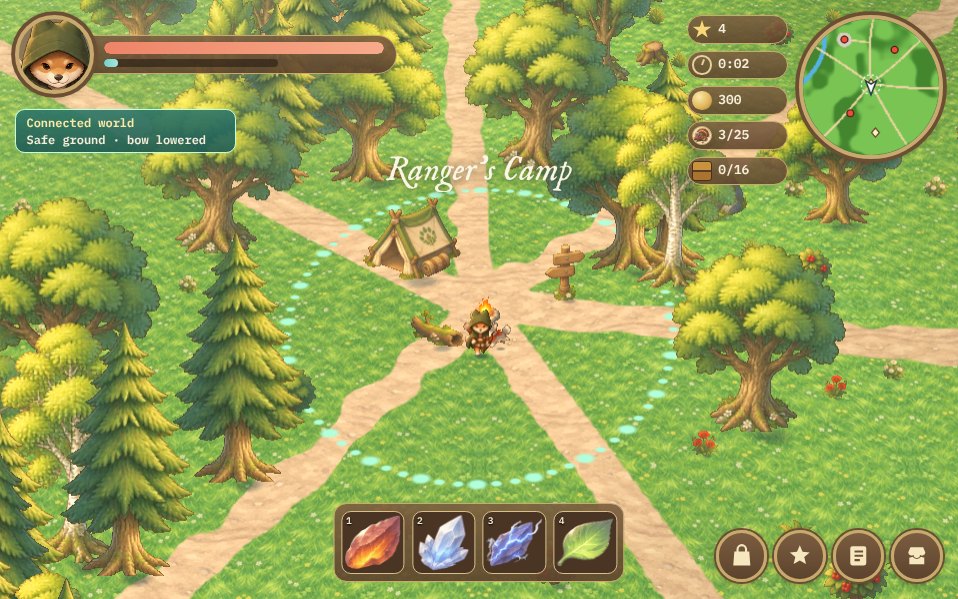
Every run starts safe at the fire. Pressing Begin puts you inside a ring of lights round the campfire: no monsters, no clock, no score, bow lowered. Step out of the ring and the run begins; the ring goes out behind you. In free roam the camp stays safe ground as before.

A guide arrow in Normal mode. A gold chevron circles the archer and points where to go: the way out of camp at the start, back to your arena if you leave its ground, and, in red, at a boss that is not already beside you. It carries the name and the distance, and keeps out of the way when there is nothing to chase. Guide arrow under the viewport turns it off.

A tidier HUD. Over a bright open world every panel costs something. The arena and boss line moved to one strip at the top centre; score and coins stay by the map while the turkey and chest counters appear only when they change; six round buttons became three (camp, menu, sound), which also stops them running into the fuse bar on narrower screens. A soft shade along the top and bottom edges keeps the HUD readable against grass and sky.

It can kill you now. The stand-in simulation let you walk through crowds untouched and never die. Monster health, speed and damage are now the live game's numbers, on the live curve: health ×1.5 an arena, damage +15% an arena from the third, speed up to ×1.6, and monsters arriving at the live spawn rate, not as an instant full crowd. Touching a monster is a hit, with the live 0.45 seconds of mercy after it. There is no free healing outside camp. At zero you fall, the run is scored, and you start again at the fire.

Monsters do what they do in the live game. Skeleton Archers keep their distance, sidestep, and loose a real arrow you can see and dodge; rocks and ruins block it. Bog Witches throw a slow orb. Thorn Boars and Orcs plant, shake, show the line, and charge. Spore Puffs swell and go off. Slimes, frogs and everything else that hops crouch and jump onto where you were standing, with a ring on the ground where they will land.

No more running off the map to be safe. Once an arena has started its monsters and its boss follow you anywhere, at that arena's strength, and the clock keeps running. Leaving the ground gives you nothing.

Damage numbers, crits and life bars. Every hit shows a number; a critical hit gets a bigger gold one, a burst of rays, a jolt, and the arrow itself glows gold in flight. Hurt monsters and bosses carry a life bar, so do the archer and each wolf. Bars are sized to the body they sit over and stay thin. Wolves can now be downed and come back after six seconds, and when they have nothing to fight they fetch: health first if you are hurt, then XP, coins and materials. About one kill in thirty drops a red mote worth 12% of your health. All of it is switchable in Menu → Settings.

Buttons under the thumb. The centred bars are gone. Bottom right is an action cluster: a big dodge roll (five-second cooldown, untouchable while it lasts), and your equipped skills on an arc round it. Skills are now pressed, with a cooldown sweep and a glow when ready; Settings has a switch to let them cast themselves as the live game does. The camp, menu and sound buttons moved up under the map.

Camp life. There is a practice target beside the fire. In the hub the archer shoots rounds of five at it, using the frames every outfit already has: a hand to the quiver, nock, draw, hold, loose. The arrows stand in the target until he walks over to pull them, then he rests by the fire and goes again. The pup, now properly smaller than him, sits, wags (a bullseye gets a wag), looks up, lies down and wanders.

Statuses you can read. Under the health bar a row of small icons shows what is on you, with the time left: green for buffs (safe ground, the moment you cannot be hit, what is fused to your arrows, Leaf Ring spinning), red for debuffs. Two debuffs are new and are mine to keep or cut: Frostpine's cold monsters chill you (35% slower for a moment, as the live Polar Bear's slam does) and Ember Canyon's imps and magma burn you (3 a second for three seconds).

Gear glow turned down. Epic and Legendary effects now sit behind and around the archer and never across his face, the ground rings are fainter, and a Legendary bow no longer whites out at full draw.

Aim what you cast. Hold a skill button and drag. Skills that land somewhere (Ember Pot, Arrow Rain, Frost Totem, Firepaw Mine) show a gold circle the size of what will land, and you place it; skills that fly (Bone Boomerang, Spinning Frisbee, Skewer Shot, Pinning Shot) show a lane you swing round the archer. Let go to cast; a plain tap still picks its own target. With a keyboard, hold the number key and aim with the mouse.

Every skill is here to try. Spinning Frisbee, Skewer Shot, Pinning Shot and Pounce Whistle now work, so all fifteen do. Unlock every skill under the viewport learns them all and opens the fourth slot. Skill damage is now the live game's percentage of an arrow, and reach and damage grow with the skill's level. Leaf Ring is a wide ring of small leaves that breathes in and out (three times the old reach at level one); the totem, pot, rain and mine all cover more ground.

Paw Tree, shop, quests, stats. Active skills have a square gold frame and an ACTIVE tag; passives are plain circles. The shop lists all twenty outfits, bows, arrows and quivers by category (you start with the plain set; +5,000 coins is a test shortcut). Quests have Claim all. The inventory shows numbers: arrow damage, crit chance and damage, shots a second, move speed, dodge, luck and the rest.

Draws, carried over from the live game. Shop → Draws has the three banners with the live odds, star rolls and guarantees: Scout (◈ 30, all 1★, Epic or better within 30, Legendary within 150), Ranger (◈ 150, 3★ with a 15% chance of 4★, Epic within 10, Legendary within 50 with the chance climbing from draw 41) and Spirit (◈ 600, 5★ with a 2% chance of 6★, a Legendary within 10, a 6★ within 80). Ten draws cost the same as nine and carry the live promise for each banner. You pay with Embers, which are 15% of the coins a run earns and are banked at every arena clear and when a run ends, or with tickets: one Scout Ticket per main boss, sometimes a Ranger Ticket from a gold chest, and more from Shop → Tickets for coins at the live prices and weekly caps. Copies stack: two at the same star merge into the next, up to 6★, and spare copies of a 6★ item release for Embers (Merge all and Release spares are in the Inventory). Shop → Items sells 1★ copies for coins at the live base prices, 25% dearer with every copy you hold; Legendaries come from draws only. Bow and arrow stars raise damage (+5% and +2% a star). Two limits: nothing is saved between visits, and outfit and quiver stars are tracked but change nothing yet, because the outfit stats and traits they scale are not in this preview. The admin test kit adds 60,000 Embers and a stack of every ticket.

The draw, staged. The rules are the live game's; the look is new. Each banner is a card with its hero, an odds bar and a ring counting down to its guaranteed pull. Drawing opens a stage: what you paid with (Embers or the ticket itself) drops into a brazier, the fire takes the colour of the best thing you are about to get, with a gold pillar for a Legendary, and the cards come out face down and turn one at a time with the best last. Skip, a tap anywhere or Escape jumps to the result; Always skip remembers that, and Settings has the same switch. Draw again and Merge all are on the result.

From guest to X account. Tap your name in the hub for the account panel. It states the live game's rule: sign in with X at any time and the device save goes with you; if that account already has a cloud save you choose which to keep, and the two are never merged. The button itself is a mock here and contacts nothing.

Skill slots that swap. In the Paw Tree, tap a slot to choose it, then tap another slot to swap the two, or pick a learned skill and send it to the chosen slot. The slot numbers match the buttons in a run.

What an item does, and what a star adds. Every outfit, bow, arrow and quiver now has a small i on its tile, in the inventory and in the shop, and every shop tile says in a line what the thing does. Tap the i for a sheet over the menu, with Equip or Buy on it: what the item gives you in plain numbers, what each star adds, and six star buttons, 1★ to 6★: tap one and the whole card is read at that star (yours is ringed). The numbers are the live game’s and they play: a bow’s damage rung and its effect (Long Shot, Shatter, Searing, Static), an arrowhead’s (more damage to monsters, faster flight, bigger crits, every Nth arrow staggering, burning or flying back), a quiver’s fire rate and family, and an outfit’s health, armour, speed and trait. A star is +5% bow damage, +2% arrow damage, +10% outfit stats, and +6% to an effect. Two quiver families are adapted and say so on their cards: Storm Link lengthens Hunter’s Rage, and Quick Draw shortens the outfit swap.

Every outfit's trait now has its own drawn effect. Twenty-four new effect paintings, one or more per outfit: Desert Nomad's sand gathers at his feet and bursts into a spinning whirl with dust flying out, and blinded monsters get sand in their eyes; Autumn Warden throws real maple leaves in a ring; Ninja Archer vanishes in smoke and goes see-through while it lasts; Elven Wayfinder's arrows are carried by green spirit wisps; Samurai Ranger's hits leave a red slash and the wounded drip until they stop bleeding; Shadow King's shots explode in hellfire; Golden Legend's arrows crackle gold and bolts drop on everything the chain reaches. The rest got the same treatment: a hunter's mark over the marked, shadow strikes, ice that cases the frozen, a golden dome for the Aegis, laser beams, brush that closes over the Ghillie, rain and puddles, a frost nova, poison bubbles and gas, rock bursts, petals and a tide ring.

Set bonuses are in. The live game's twelve sets, straight from its code: the outfit you are wearing with one particular bow (Forest Ranger with the Wooden Longbow is the Greenwood Kit, Golden Legend with the Lightning Bow is Stormcrown, and so on). A chip under the figure says whether your set is active or which bow it needs, the tile that completes it carries a SET tag, every outfit and bow sheet names its set and partner, and an active set shows as a green-ringed icon under the bars in a run. Swapping outfits mid-run changes the set with it.

What you are wearing, spelled out and on screen. The inventory opens on your items again: figure, slots and the two outfits on one side, the full grid straight away on the other (an earlier pass had pushed the grid far down the page). Below the figure, What you are wearing gives you lists every piece you have on and what each is giving you at its star: outfit, bow, arrow, quiver, and the packed outfit when Season Turn makes it count. In a run the same pieces sit as gold-ringed icons under the health and XP bars, beside the icons for active skills. A trait on a timer shades and counts down until it is ready. Hover an icon to read it, or tap it on a phone.

Fuse is gone. It was this study’s own idea and not part of the game’s design. The button, the key and the status are removed; materials still drop and count as XP.

Rings that stay on the ground. In Greenwood a wide skill ring could sink into a hill and vanish. Ground rings are now always drawn over the ground they lie on.

Both feet down. Facing you, every shooting frame had been drawn mid-step, so standing still looked like a frozen walk. All twenty outfits were redrawn there with both feet planted, and he breathes while he stands. And he sits. Leave him alone for four seconds, or let him rest by the fire in the hub, and he crouches and sits down with his paws on his knees, bow propped beside him, with a happy squint now and then. Any input stands him up.

A camp that holds a full pack. With three pups and the great wolf the hub had animals standing in the firing lane and lying under the bottom panel. Everyone now has a place: pups sit beside the archer or in a row in front of the line, and the great wolf has a den of its own with new resting art (sitting, head up, lying watchful, asleep) in place of a frozen running frame. It is drawn smaller at the fire than in a fight, and a bullseye still gets a look up. Phones get their own places because they frame a different strip of the camp.

Tools for testing. Settings → Testing has two new ones. Start a run in an arena begins a fresh Normal run inside any of the six, seals lifted, monsters at that stage’s numbers. Monster swarm brings monsters at the late-game rate from the first second, anywhere. Take the test kit first.

Skills, after playing them. Moon Howl no longer shoves the crowd back: it rolls out in a wide ring and stuns everything in it for 2 s, half a second longer per level (bosses shrug it off), on top of the wolves’ dash and the rally. Thunder Kite is now Lightning Shield: six seconds of a shield that soaks damage worth 35% of your health, blocks each hit outright, and answers it by stunning and striking the three nearest monsters. Leaf Ring grows 25% a level, so at level five it is twice as wide with twenty leaves. Ember Pot burns a pool more than half as wide again. These are my numbers on your direction, not the live game’s.

Take a skill out in one tap. Every filled slot in the Paw Tree carries a small red ×, and there is a Clear all.

The bow and quiver you equip are the ones he carries, on every outfit. Until now only the outfit changed the character: each outfit’s drawing had one bow and one quiver painted in. Now all twenty outfits are drawn with empty paws and a bare back, and the game lays the equipped bow, quiver and arrow onto him: in his paw as he walks, raised and bent as he draws with the string pulled back and your arrow type on it, and the quiver across his back, lying over his tail when he faces away. Any of the twenty bows with any of the twenty quivers, and the inventory figure shows the same. It began as a trial on three outfits; the other seventeen needed 102 sheets redrawn without gear and no new hand work, because every outfit turned out to share the same poses to within a few pixels. What it is not: the bow is one painting bent at the grip, not redrawn for each frame; facing away, the arrow on the string is not shown; and it has not been on a real phone.

Two outfits, swapped mid-run. Everyone has two outfit slots, no more. In Outfits they sit side by side as 1 Wearing and 2 Packed with a swap button between: tap a slot, then an outfit to put it there. In a run the packed outfit’s face sits beside the roll (or press Q) and swaps you into it, with the live game’s 30-second cooldown. Outfits now carry the live game’s health, armour and speed, and their signature traits (below), so the swap changes how you fight. Season Turn, the Spirit capstone, used to fire every skill on a timer, which means nothing when skills are pressed: it now gives you your packed outfit’s trait, health, armour and speed on top of the one you wear, and a 20-second swap.

Every outfit’s trait plays. All twenty signature traits from the live game are in, at their Tier I numbers, and the inventory spells out the one you are wearing. Forest Ranger marks a monster with every sixth arrow; Night Stalker’s first hit on anything lands 60% harder; Snow Scout slows and freezes; Desert Nomad throws a sand burst every eight seconds; Autumn Warden looses a ring of leaf arrows; Royal Guard blocks a hit outright every eight seconds; Ninja Archer vanishes in smoke when struck; Elven Wayfinder’s arrows curve to their targets and he looses one more; Samurai Ranger bleeds; Cyber Ranger pierces two more, harder each time; Shadow King’s hits explode and burn the ground; Golden Legend chains lightning and revives once a run; Ghillie Scout goes unseen standing still and ambushes for double; Rain Ranger leaves slowing puddles and mends; Ranger Captain calls a volley on the thickest crowd; Frost Ranger freezes whatever hits him; Marsh Ranger poisons, and the poisoned burst into gas; Mountain Ranger knocks back and grows tougher each arena; Blossom Ranger heals on kills; Coast Ranger pulls in every coin on a wave. Not carried over: the tiers (II and III are bought mid-run in the live game, which this study does not have) and Shadow King’s Hell clause.

Wardrobe Start is now a spell: Spirit Double. With a second outfit given to everyone the old node had nothing to give. Pressed and placed, a spirit double of you stands for five seconds; every monster in a wide circle turns on it and leaves you alone, and when it fades it bursts for 220%. Bosses ignore it.

More skills, after playing them. Arrow Rain is a wide circle that keeps falling: 1.5 s at level one, half a second longer and 12% wider each level. Skewer Shot’s lane widens with every level, to more than double. Pinning Shot pins for 2 s, and a boss for 1 s, which also makes it drop what it was winding up. Quiver Storm is now Hunter’s Rage: a ring of arrows is worth little late on, when you are already filling the screen with them, so pressing it now gives six seconds of 60% faster shots, 30% faster feet and 30% more damage on everything you do. Moonlit Draw, the Marksman capstone, was only listed; now every eighth, seventh or sixth shot carries a moonbeam for 300% through everything on its line.

Hood Lantern, relit. One puff every two seconds was not worth a slot. Pressed, the lantern now burns for 8 seconds and goes where you go, pulsing a wide ring every 0.7 s that hurts, slows and sets alight.

Also in this pass: hold + or − on the level-up panel to pour stat points in or out. Leveling up fully heals you, including any max HP the new points add. And every bow has its own release sound: twenty recipes, rebuilt from scratch after the old twang read as a cartoon. They are in the sound board below under their own names.
Before a merge: what the live game has that this study does not

This study replaced the game's simulation with a stand-in so the art, camera and sound could be judged. Everything below lives in the existing engine and React shell. The sound way to merge is to keep that engine and state and swap only the drawing and the presentation, not to rebuild these one by one: in engine.js the drawing sits in one block of draw…() functions at the end of createGame, which is the part this renderer replaces.

Missing hereWhat the live game doesFor a first test
DeathThe archer can die; game over, and Hardcore wipes coins, gear and stars.Partly here: he dies and the run is scored, but nothing is lost or saved.
SavesCheckpoints, Continue across sessions, cloud save, separate profiles. The standing rule is that saves, items, star ranks and currencies are never reset.Blocking. Nothing here survives a reload.
Real numbersTuned prices, stats, drop rates, XP curve, monster and boss health. Boss scaling is frozen.Partly here: monster and boss health, speed, damage and spawn rate are the live ones. Prices, drops, XP and the player's own growth are still placeholders, so later arenas are not balanced.
ElitesTwo elite slots a visit, at 35 s and 85 s, with swift, armored, vampiric and splitter variants.Blocking for difficulty.
Boss move setsTwenty named attacks with telegraphs (gore, thorns, rootline, bone rain, breath, moon orbs, blink and the rest).Blocking. Bosses here share three generic attacks.
HellHell Mode loops after the sixth arena, Hell Trials and its select screen.Needed for anyone past Normal.
Accounts and ranksX sign-in, weekly and all-time boards, Saved and Hardcore boards, Player and Test badges, score submission.Needed. Ranks here are a list on this device.
Gear depthOutfit traits, set bonuses and set focus; star ranks, the 6★ merge, selling spares; quick outfit slots with a 30 s swap cooldown.Needed. Gear here is looks, effects and a few stats.
Draws and currenciesBanners, tickets, the ticket shop, weekly limits, Embers; wallets, holder perks and beta keys.Mostly here: the three banners, guarantees, tickets, the weekly ticket shop, Embers, merge and release use the live numbers. Not here: Set Focus (off in a live build too), wallets, holder perks, beta keys, selling spares for coins, and any saving.
In-run shopThe bow ladder, run arrows and quivers, the Supply Crate.Needed. The shop here sells six plain pieces.
CardsThe arena draft, cards that last one arena, evolutions from a skill plus its pair card.Needed for build variety.
SkillsFrisbee, Skewer, Pin and Pounce, about a third of the tree's passives, per-skill cast toggles, buff icons.Can follow; the tree itself is the live one.
QuestsDaily, weekly and monthly sets, the 26-step Story series, Claim all, login streak, gifts and boosts.Can follow. Six sample quests here.
Settings and comfortDamage numbers and HP bar options, haptics, the rotate gate, view zoom, graphics level, reduced motion inside a run.Can follow, but phones need the rotate gate.
Help and toolsThe Game Guide, replays, the auto bar, admin tools and sandbox, the test suites.Tests must come across with the engine.
Movement detailEight facings; monsters that cross water.Can follow. Four facings here.
Sound

Sound and music for everything

One thing to know before you listen: I cannot hear. Everything here was made and checked by measurement — loudness, timing, frequency balance, and reading spectrograms — not by ear. The engineering is sound; the taste is yours to judge. The sound board below plays every track and effect on its own so you can tell me exactly which ones to redo.

LayerWhat is inHow it behaves
ScoreTen original loops, a main theme for the title and hub and one per region plus Harvest Fields, camp and boss, written as one suite: a small folk orchestra with a different lead colour in each place. Five stingers: boss arrives, arena cleared, all six cleared, level up, a seal lifts.Follows the region with a crossfade, after a moment's delay so a border does not flicker. Switches to the boss theme while a boss is up and to the camp theme on safe ground. A low-pass filter opens as monsters close in and shuts behind menus and the level-up panel. Stingers duck the loop.
AmbienceA bed for each of the seven biomes, plus a campfire and a water's-edge bed.The biome bed follows the ground under you. The campfire and water beds are tied to places: they fade up as you walk toward a fire or a shore.
Effects122 sounds, 133 files: a release for each of the twenty bows, with a fused spell heard on top of it, hits by what the arrow lands on, fourteen ways for a monster to fall, footsteps on five surfaces, wolves, bosses (footfalls, wind-up, slam, charge, volley, and a collapse per boss material), every spell, pickups, three chests, the seal, gear effects, and the whole interface.Placed in the world: panned by where it happens, quieter and duller with distance. Every sound has a cooldown, a voice limit and a priority, so 600 monsters cannot turn it to mush; big moments duck the small ones.
MixThe live game's chain: four buses (music, effects, ambience, interface), a compressor and a soft ceiling. Music levelled to one loudness, effects to set peaks.Master, Music, Effects and Ambience sliders under the viewport, remembered on this device. The speaker button mutes.
Sound board

Hear any one thing

Click a pill to play it. Music and ambience loop until you click again; the game's own music steps aside while you listen. Effects with several takes rotate through them on each click.

Where the sounds came from, and what that means

Music was generated for this study with ElevenLabs Music through your Higgsfield account, from prompts I wrote for each region. Each track is cut to a seamless loop by finding the two points whose following three seconds match best, and levelled to −17 LUFS. The live game's music today is mostly Kevin MacLeod tracks under CC-BY plus one original; this would replace it with a single matching suite. Check the generator's licence terms for commercial use before shipping.

Effects are designed, not downloaded: each is a recipe of synthesis layers — a string slap, a limb thud and the knock of the stave for each bow, struck-object models for coins, bells and bone, shaped and swept noise for whooshes and impacts — with a slice of a generated clip as texture where one was good enough. I generated 93 effect clips first; about half failed checks (near silent, or all sub-bass rumble), which is why the recipes exist. The upside is that every sound is reproducible from one script, starts exactly on its attack, and can be retuned by changing a number.

Phone speakers: anything under about 150 Hz is inaudible on them, so every effect is capped at 40% low-band energy and gets added harmonics of its own bass. Impacts keep their weight on headphones and still read on a phone.

No animal voices, as in the live game: wolves are paws, a jaw snap and claws; the Moon Howl is wind; monsters fall by what they are made of; ambience has no birds, frogs or insects.

The direction

Bright, sunlit, and drawn by one hand

Three corrections from the last pass, all of them yours. It was too foggy: haze now starts beyond the far edge of play and never covers more than a sliver of the frame. It was too muted: the palette is the key frame's — saturated spring green, real reds, a blue lake — not the grey-sage of the old roster. And it was not consistent: every sprite on this page was painted in one run against the same two references, your archer and the Greenwood key frame, with the same outline, the same sun and the same camera written into every brief.

One outline, everywhere

A thin warm dark-brown line of even weight around every sprite, from a daisy to the Gobbler. It is the cheapest consistency rule there is and the one the eye checks first.

Bright and saturated, sun from the upper left

Warm light side, cool shadow side, on every asset. Colour is allowed to be loud; what keeps it readable is that the ground is always a little quieter than whatever stands on it.

Scale is a table, not a feeling

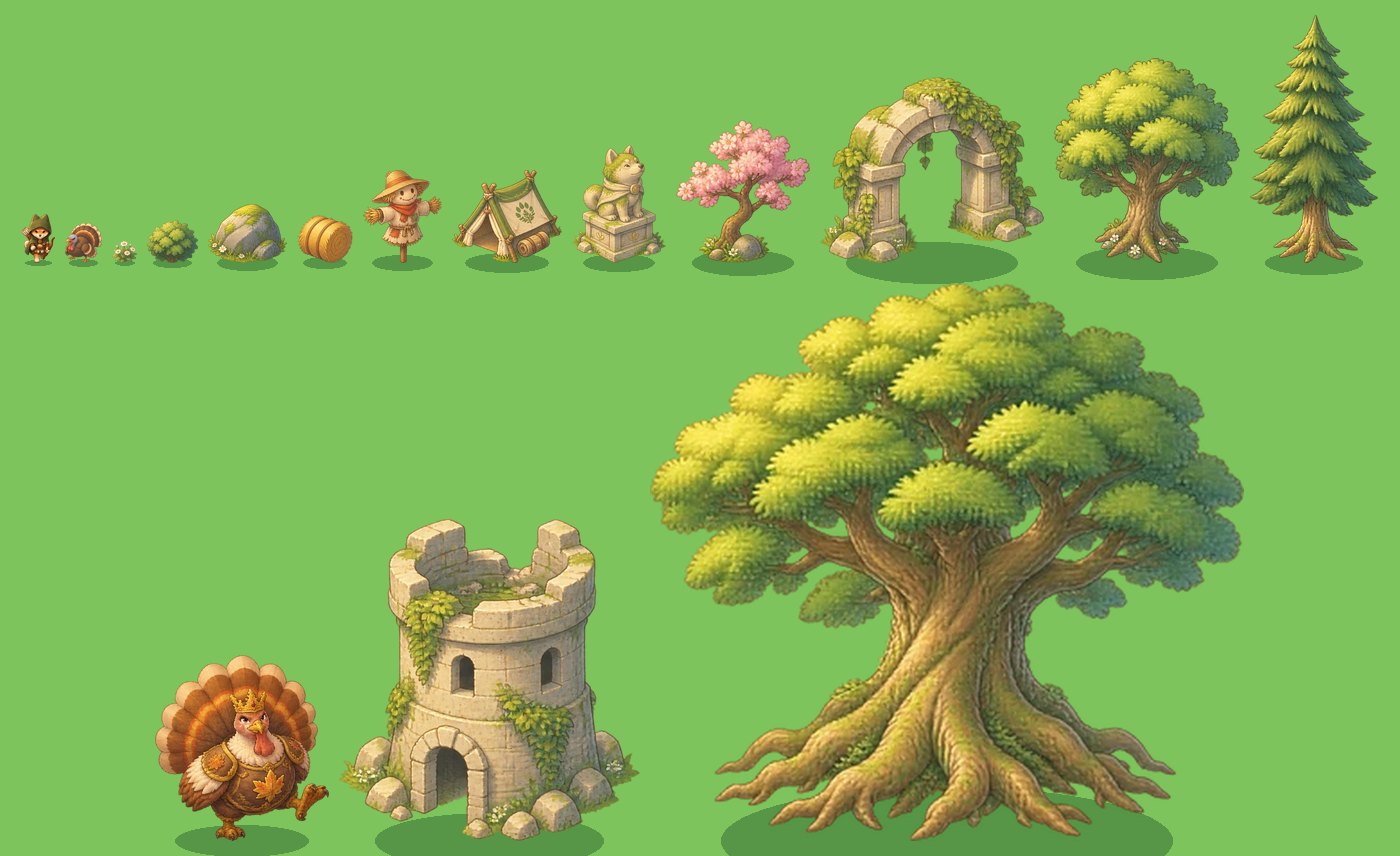
The archer is 78 units tall and everything else is a number relative to him: a bush 70, a boulder 95, an oak 330, a pine 400, the watchtower 520, the Elder Tree 900. The table lives in the atlas builder and nothing is sized by eye.

Every biome owns a colour

Green, cream stone, teal, white, terracotta, pink, gold. You should know where you are from the ground alone, with the HUD off, in under a second.

Silhouette before detail

Every monster identifiable as a black shape at 40 pixels. With 200 enemies on screen that is the whole readability budget, and it is why the roster is built from round, spiky, tall and wide shapes rather than variations on one.

Landmarks you can steer by

A tree nine times your height, a watchtower, a line of red gates up a hill, a ring of ember crystals. Each biome has one thing visible from a distance, so the map is somewhere rather than a texture.

Sprites lined up at true relative scale: archer, turkey, daisies, bush, boulder, hay bale, scarecrow, tent, statue, small cherry tree, archway, oak, pine, the Gobbler, a watchtower and the giant Elder Tree
True relative scale, straight from the atlas. The archer is far left. Last time a sapling and a boulder were nearly the same height; now a tree is four to five times the hero and the Elder Tree is more than eleven.
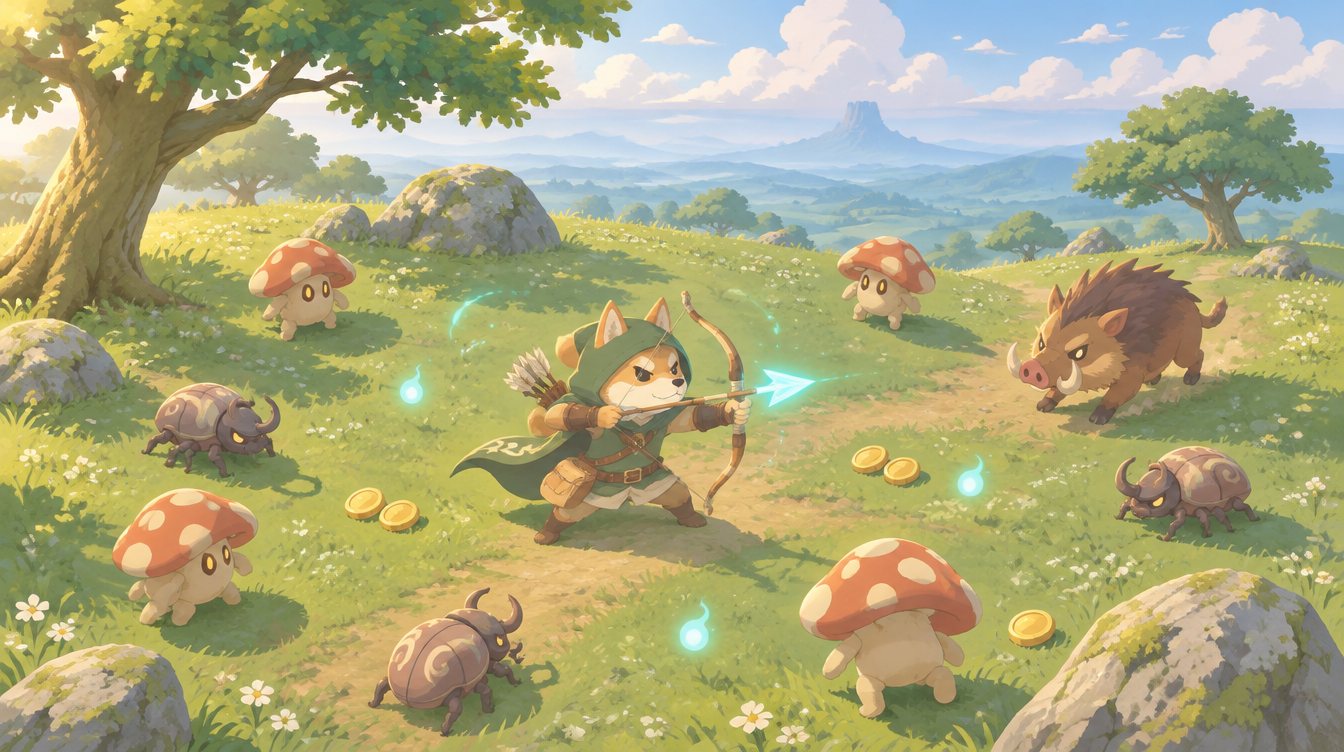
Sunlit meadow seen from a high angle, chibi archer at centre ringed by monsters, pale layered hills receding to the horizon
Greenwood, the key frame everything was painted against. This is the brightness you asked for, and the second reference image handed to every sprite brief on this page.
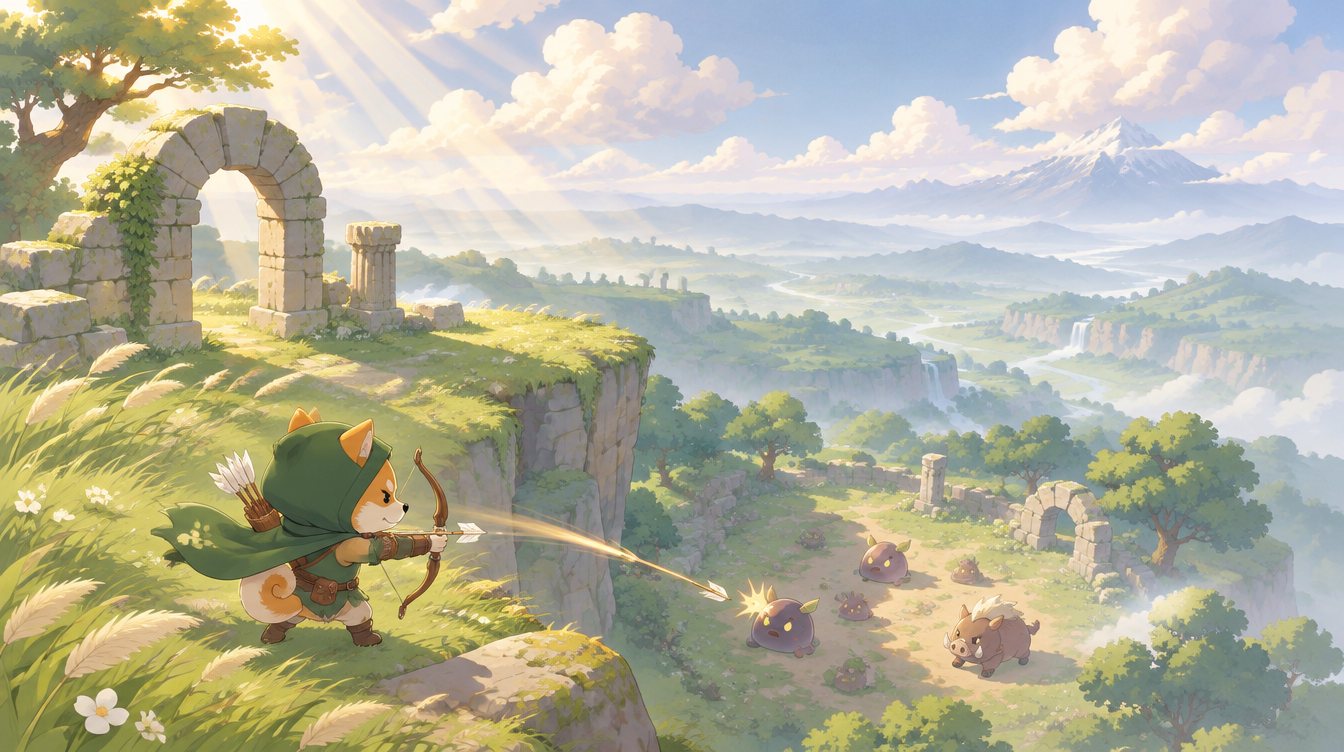
Archer on a cliff plateau firing down into a basin, layered valleys and mountains fading into haze
What the camera is for. Distance, elevation and a sense of somewhere. Shallower than the playable pitch on purpose — this is the hub, the between-runs frame, and the key art. Drag the pitch slider down to about 32° in the viewport and you get close to it.
The contract

50°, one sun, four facings

Billboards never rotate to show you another angle, so the camera pitch is an art specification rather than a render setting. Every character is drawn as if seen from this one angle. Change it after the art is made and all of it is redrawn, so it gets fixed now, in writing.

Pitch50°Hood and shoulders read from above, paws foreshorten. Below 45° you lose track of what is behind you; above 60° you have paid for a 3D world and are looking at a floor plan.
Lens32° verticalEnough perspective to read terrain, not enough to bend the edges of the screen.
SunUpper left, 35°One direction for every asset in the game. Warm key, cool transparent shadow.
Facings3 drawn, 4 shownSouth, north and east are drawn; west mirrors east. That is what the live engine already uses, and it keeps an outfit to six sheets instead of sixteen.
AnchorFoot at the ground pointAlready how the current draw code is anchored, so nothing in the engine changes.
BillboardFully camera-facingSprites keep their full height instead of foreshortening with the camera.
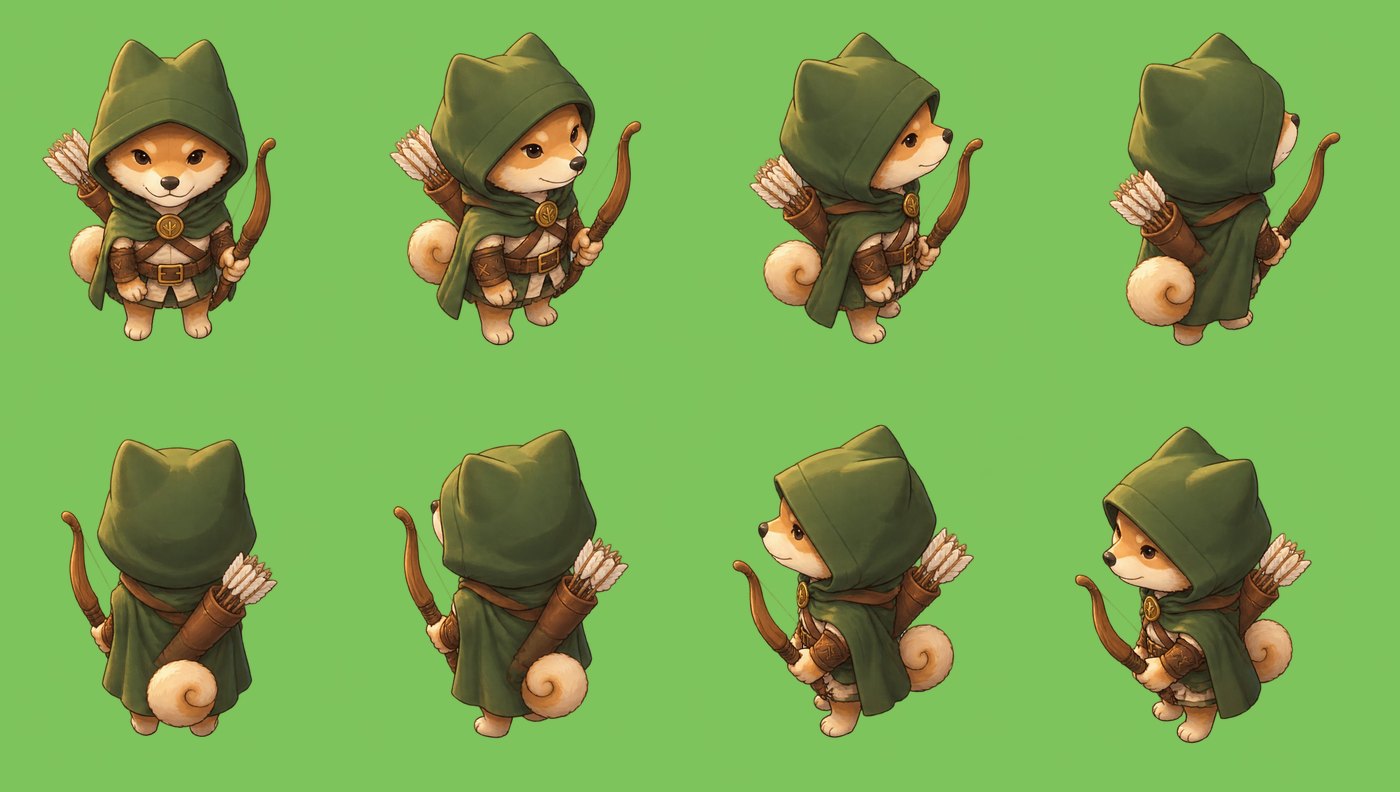
The redesigned Shiba archer from eight directions: slimmer, with the hood covering his ears in two soft peaks
The archer, locked. Ears under the hood, so the hood itself carries the silhouette; narrower shoulders and cloak; same face, same tail. This is the design you picked and the one in the viewport.
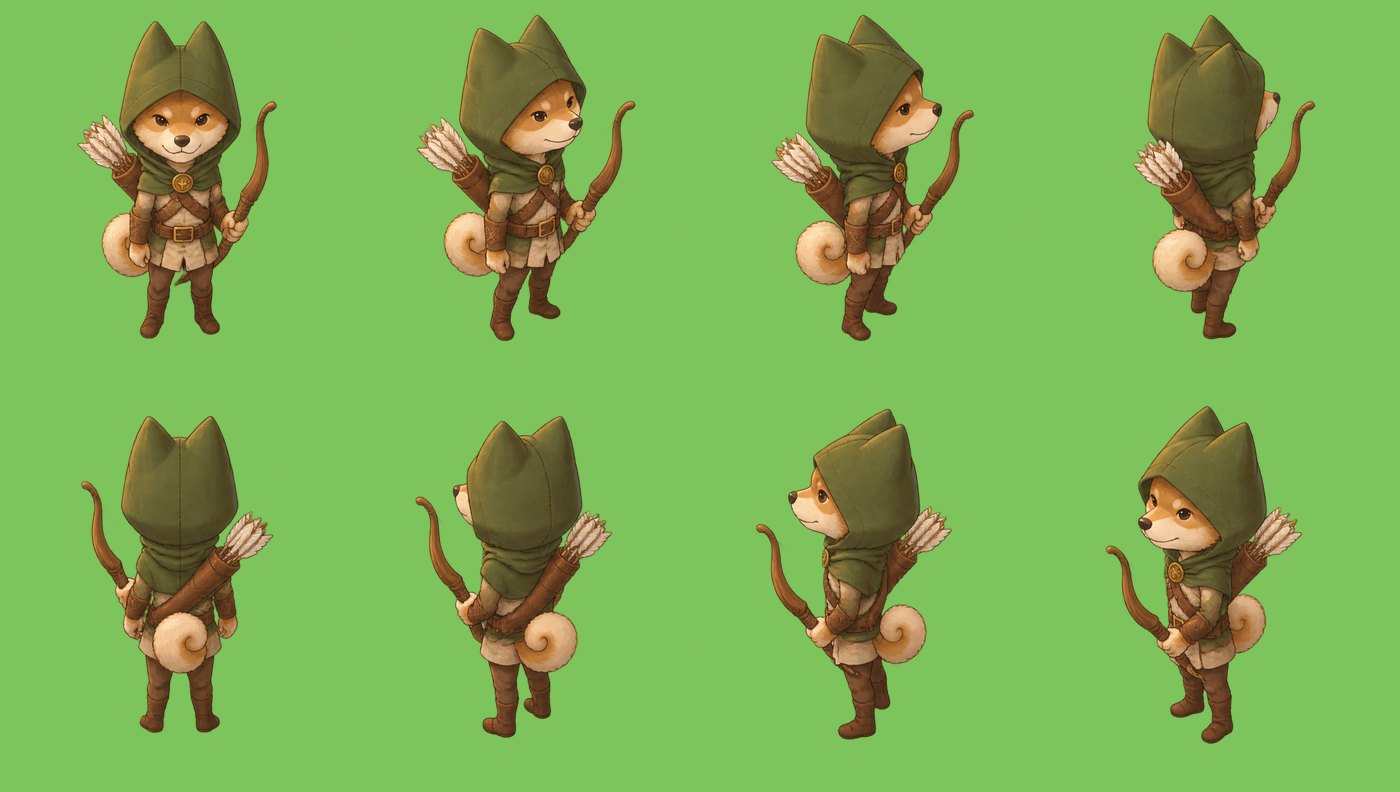
A leaner, taller alternative take on the archer with longer legs and boots
The option not taken. Leaner and taller, with boots and a hip-length cloak — more athlete, less mascot. You chose the first, and every animation set on this page is built from it.
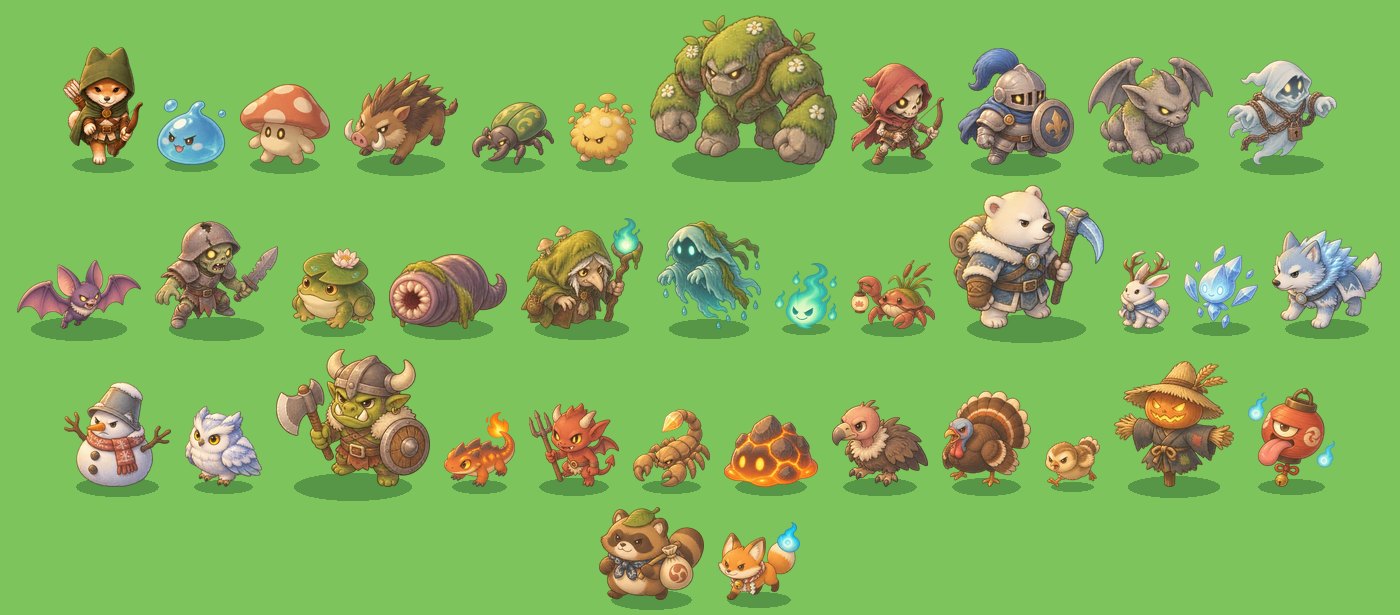
The archer followed by thirty-six monsters in one bright consistent style, including a wild turkey and a turkey chick
The roster, tripled: 36 monsters. All 20 from the live game redrawn — slime to orc warrior, plus the Wild Turkey — and 16 new ones so every biome has six of its own: a horned snow hare, an ember lizard, a lantern spirit, a tanuki bandit, a turkey chick that charges.
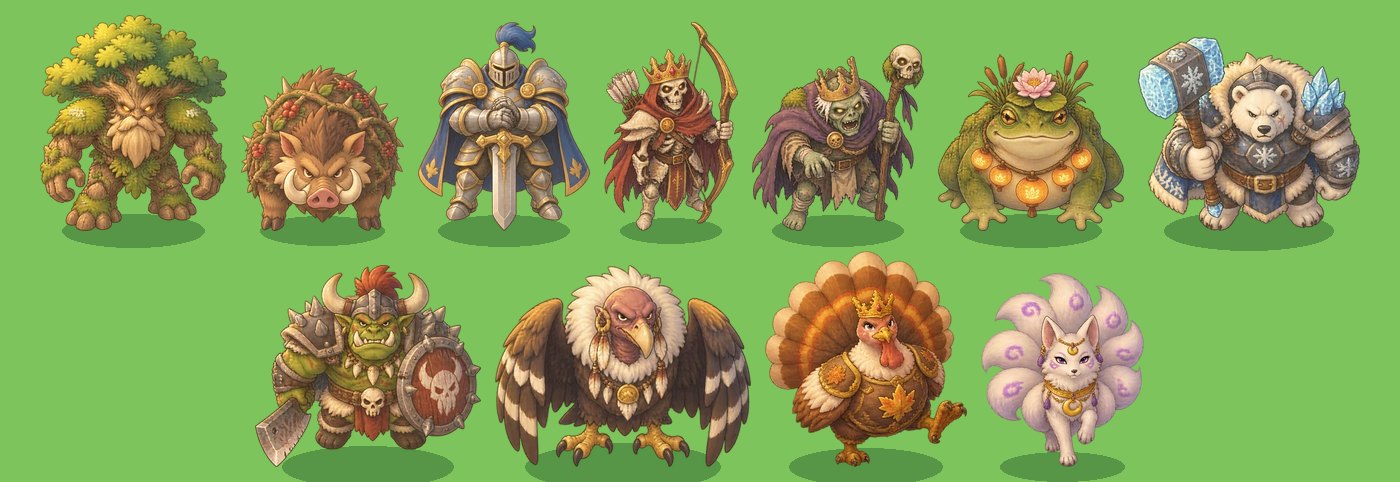
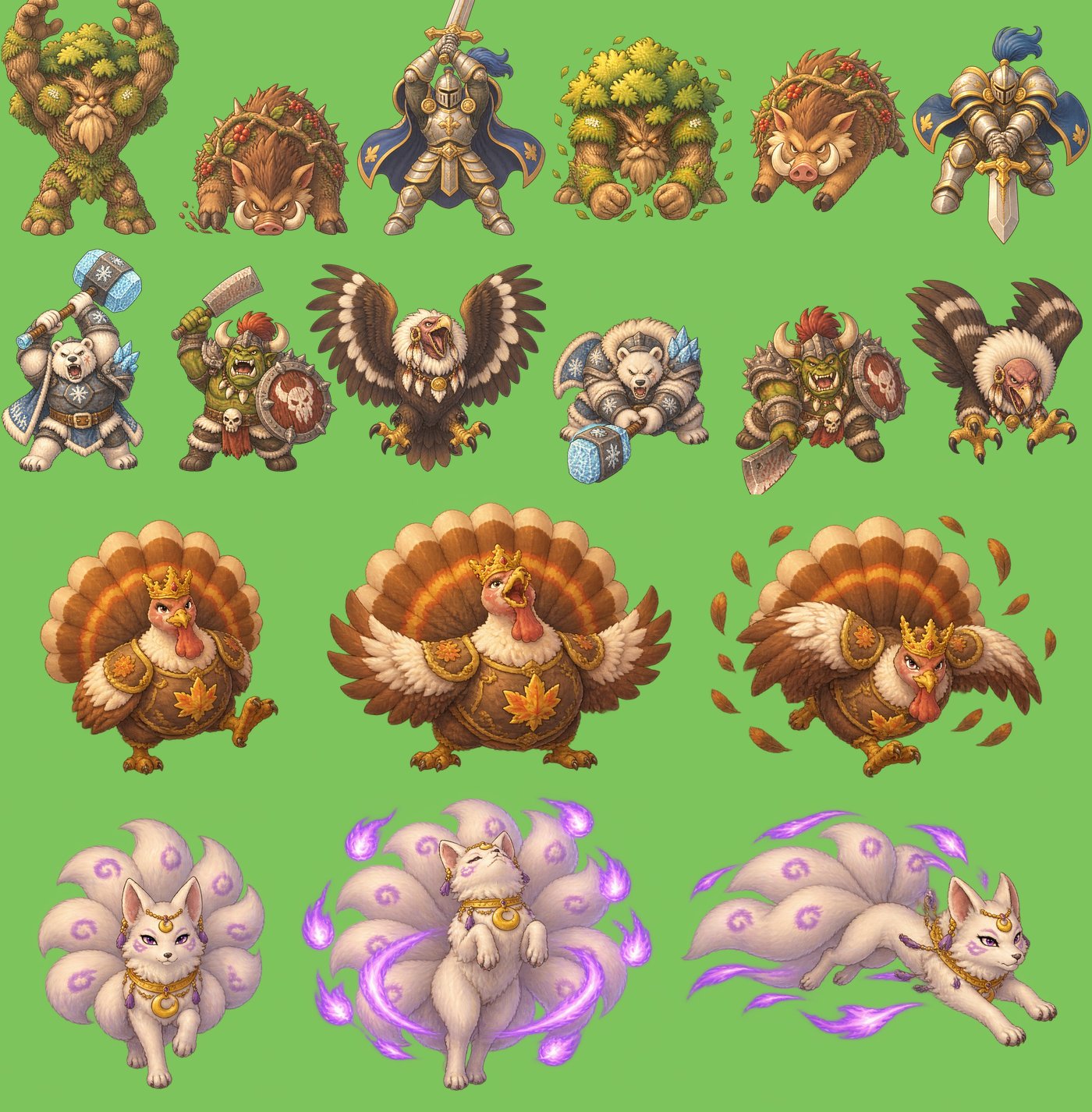
Eleven bosses in the same style: Elder Treant, Giant Thorn Boar, Iron Warden, Skeleton Lord, Zombie King, Bog Queen, Polar Bear Warlord, Orc Chieftain, Canyon Condor Matriarch, the Gobbler turkey king and Moon Fox Kitsune
All eleven bosses from the live game, in the new hand. Including the three newest: the Canyon Condor Matriarch, the Moon Fox Kitsune, and the Gobbler in his crown and maple-leaf breastplate.
A finding that still stands

With this lens the pitch has to drop below roughly 16° before any sky enters the frame, so in play you never see a horizon. Depth has to be manufactured: a band of tall scenery at the edge of the draw distance with only a little haze on it. Switch off Treeline to see the world without it, or drag the pitch to 14° to meet the real horizon and the reason nobody will play there.

Movement

Drawn frames, and a gait for every creature

The duck walk came from one trick applied to everything: rock the whole sprite from side to side. It is gone. Movement now comes from drawings — the next pose of each creature, redrawn from its own sheet so it stays on-model — and from six different ways of crossing ground. A slime only travels while it is in the air and squashes when it lands. A beetle scuttles in bursts and never bobs. A bat flaps on a wing beat and a ghost drifts on a slow one. A boar leans into a run.

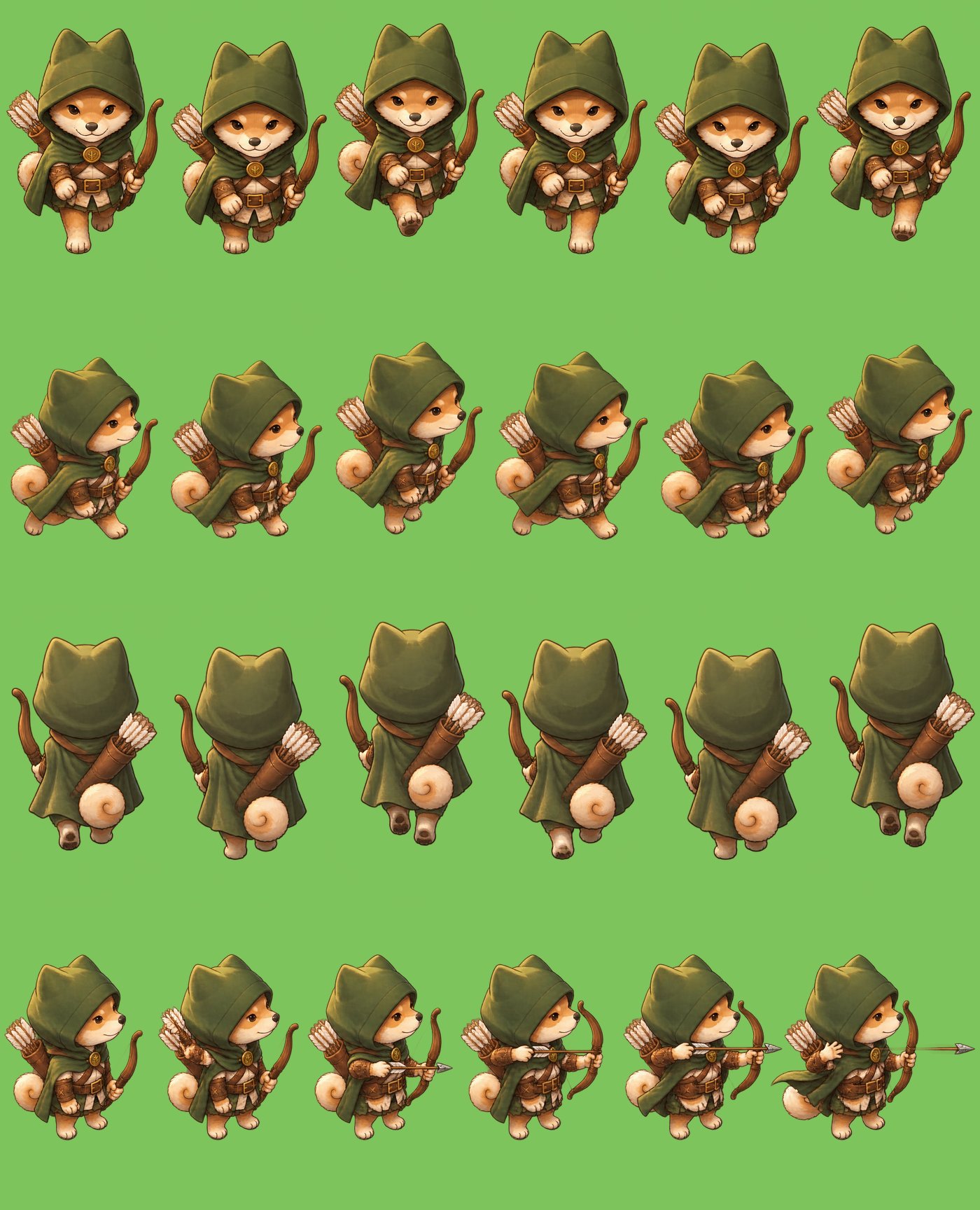
Four animation strips of the archer: walk cycles facing south, east and north, and a six-frame bow shot
The archer's sets. Six-frame walk cycles facing south, east and north, and the bow shot: ready, reach for the quiver, nock, half draw, full draw, release. There is a shot set for each facing too. Standing still he plays the whole draw and looses on the last frame; on the move he snap-shoots so the walk never stalls.
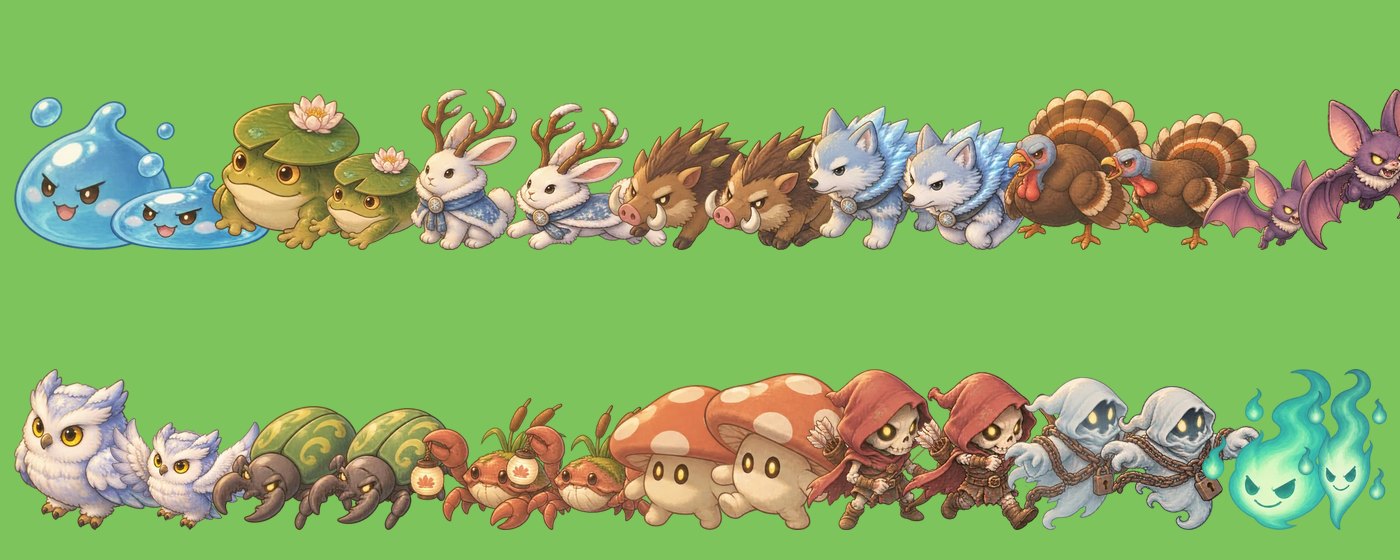
Pairs of animation frames for fourteen monsters, such as a slime squashing, a frog leaping and a bat flapping
The first pass: two frames each. Left of each pair is the rest pose, right is the travelling one.
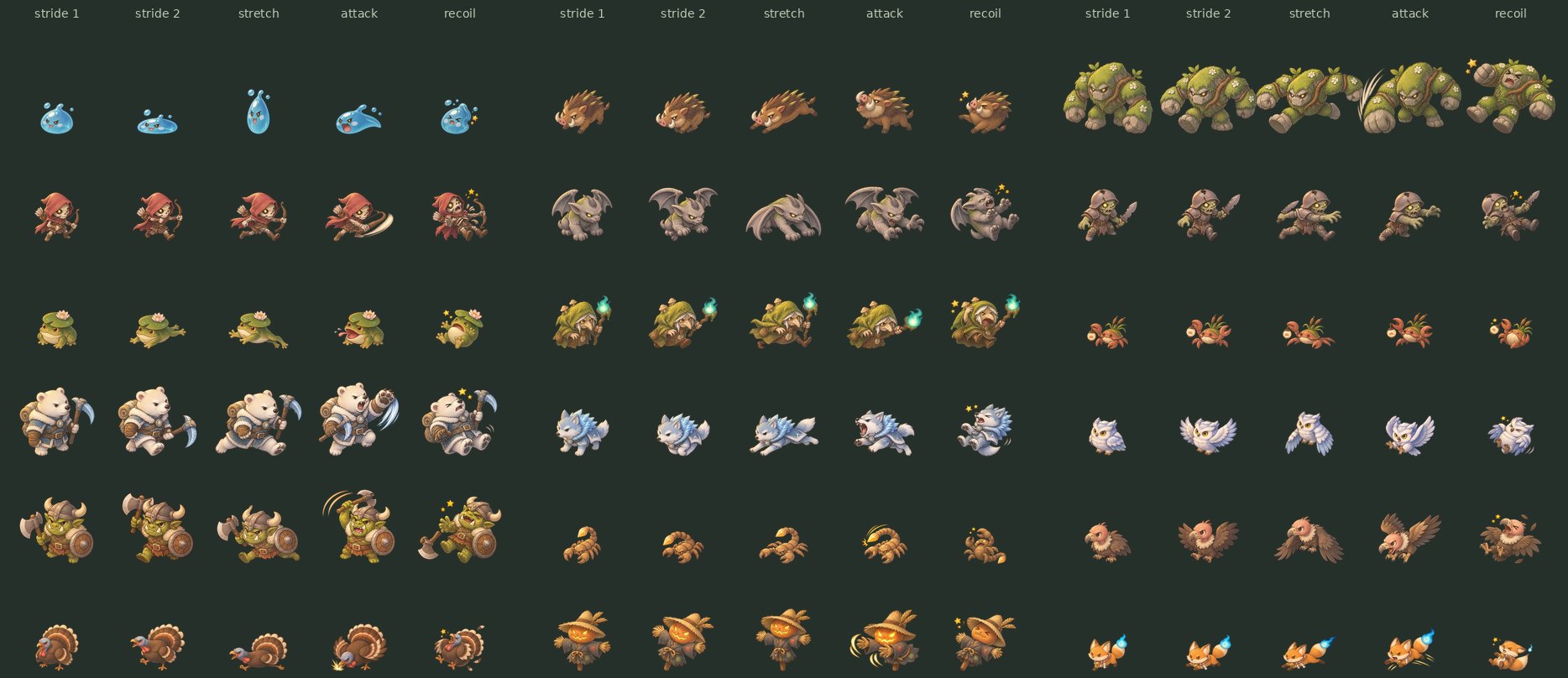
Eighteen monsters, each shown in five frames: two stride poses, a stretched pose, an attack and a hit recoil
Now five frames each, for all 36. Two ends of the stride and the stretch between them, then the attack and the recoil. A monster that reaches you stops, plays its attack and lunges; the hit lands in the middle of the lunge, so there is something to read and dodge. Shoot one and it flinches back a step in its recoil frame.
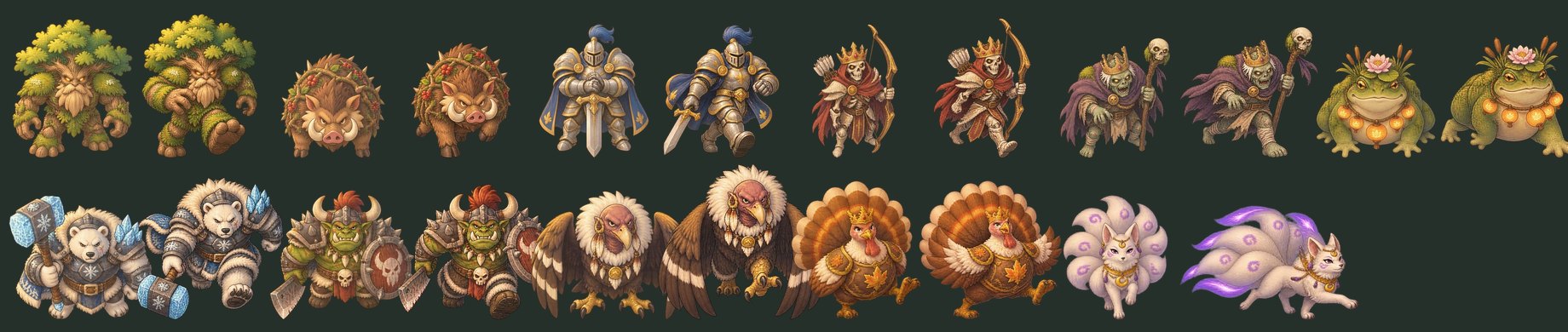
Eleven bosses, each shown in its standing pose and a mid-stride pose
A stride frame for every boss. Stance on the left, stride on the right. They alternate on each footfall, so a boss now has four drawings: stance, stride, wind-up, strike.
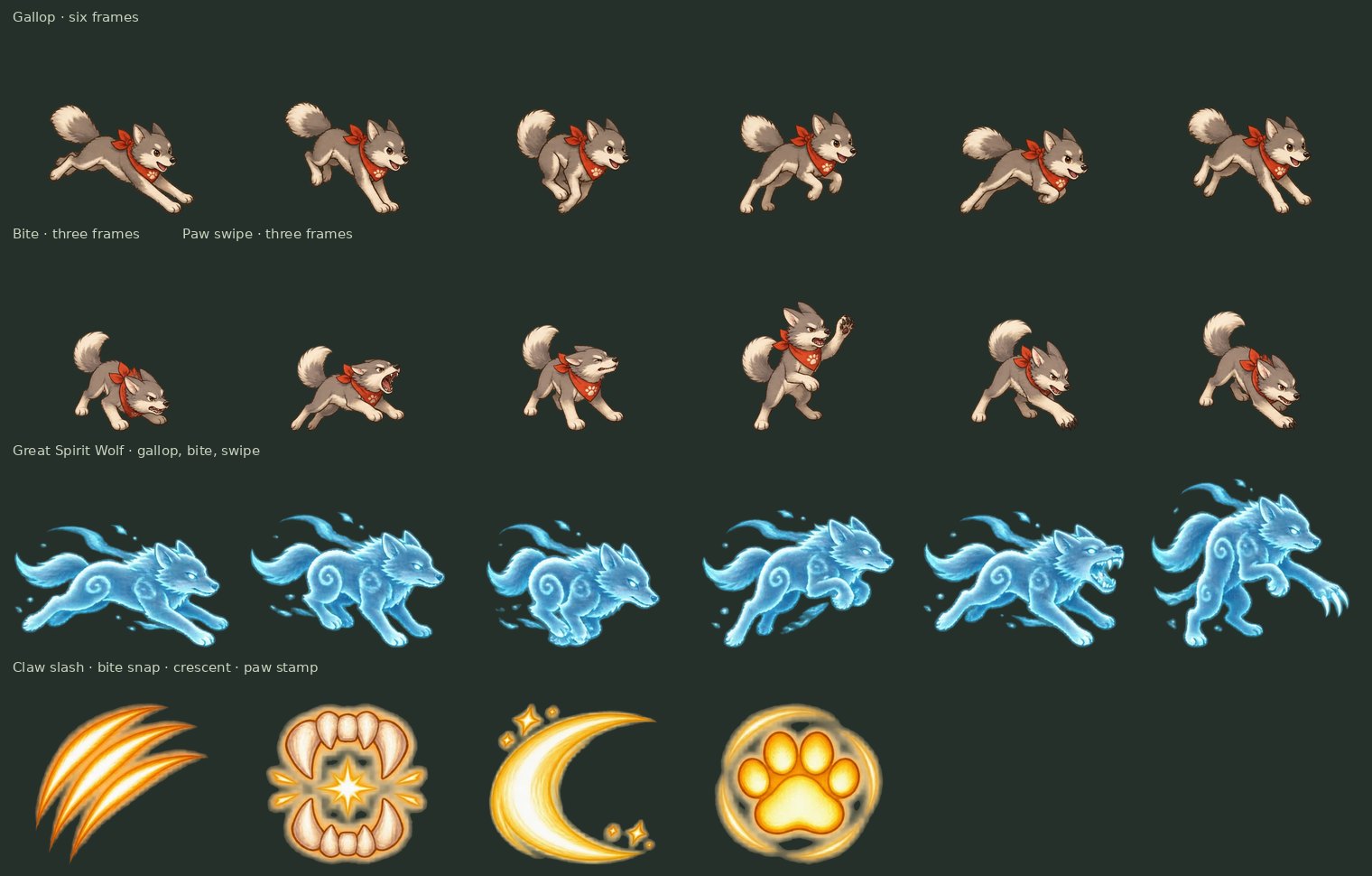
Animation strips for the wolf: a six-frame gallop, a three-frame bite, a three-frame paw swipe, the blue spirit wolf running, biting and swiping, and four effect sprites
The wolf. The puppy is now a young wolf, same colours, same bandana. The gallop advances one frame every 22 units of ground, so the legs are tied to the distance actually run and never slide. In reach it bites one target hard; when its target stands in a knot it rears and swipes, and the swipe hits up to five. The Great Spirit Wolf (the Wolf Pack capstone) swipes every time and hits seven.
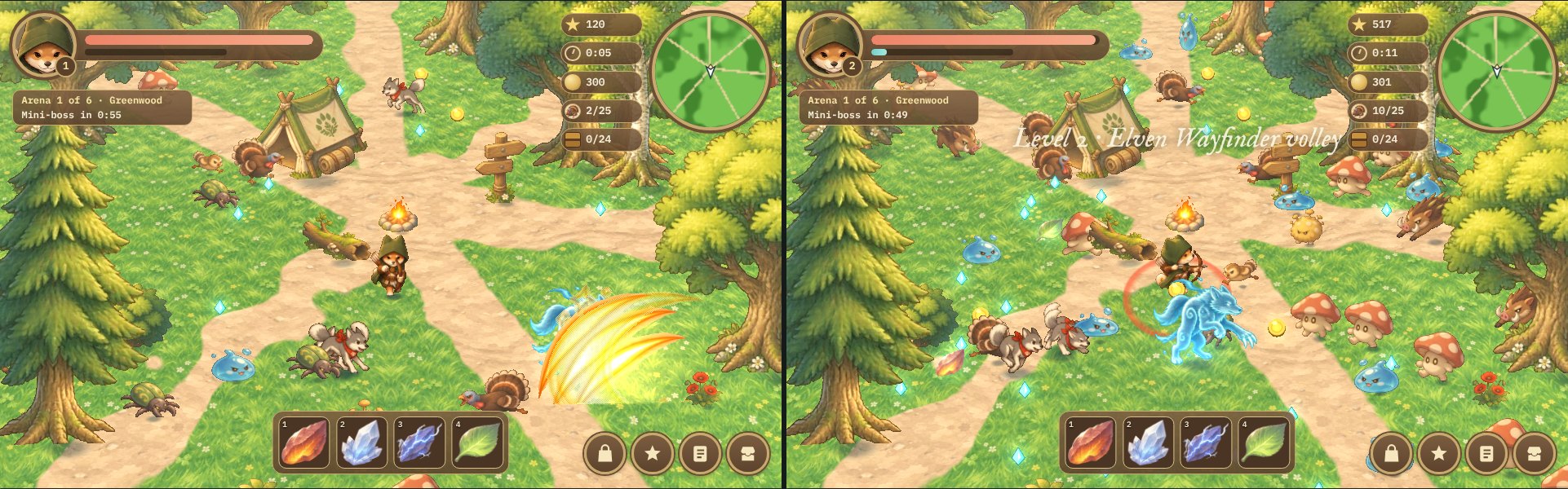
Two screenshots of play: a claw slash cutting through a group of monsters beside a wolf, and three wolves and a blue spirit wolf fighting around the archer
In play. Left, a swipe landing. Right, a full pack: Pack Call, Guard Wolf, Bigger Pack and the Great Spirit Wolf, all bought from the tree.
Boss wind-up and strike poses: a treant raising and slamming its arms, a knight swinging a greatsword, a bear with a hammer, a condor diving, and the Gobbler and Kitsune striding, rearing and charging
Bosses commit. Wind-up on the left of each pair, strike on the right; the bottom rows are the Gobbler and the Kitsune striding, rearing and lunging. In play a boss surges on each footfall, plants, shows you the ring where it will land, and then goes: slams for the Treant, Warden, Warlord, Chieftain and Zombie King; a locked charge for the Boar and the Gobbler; a leap for the Bog Queen, Condor and Kitsune; a fan of shots from the Skeleton Lord.
Wardrobe and armoury

Twenty outfits, bows, arrows and quivers, redrawn

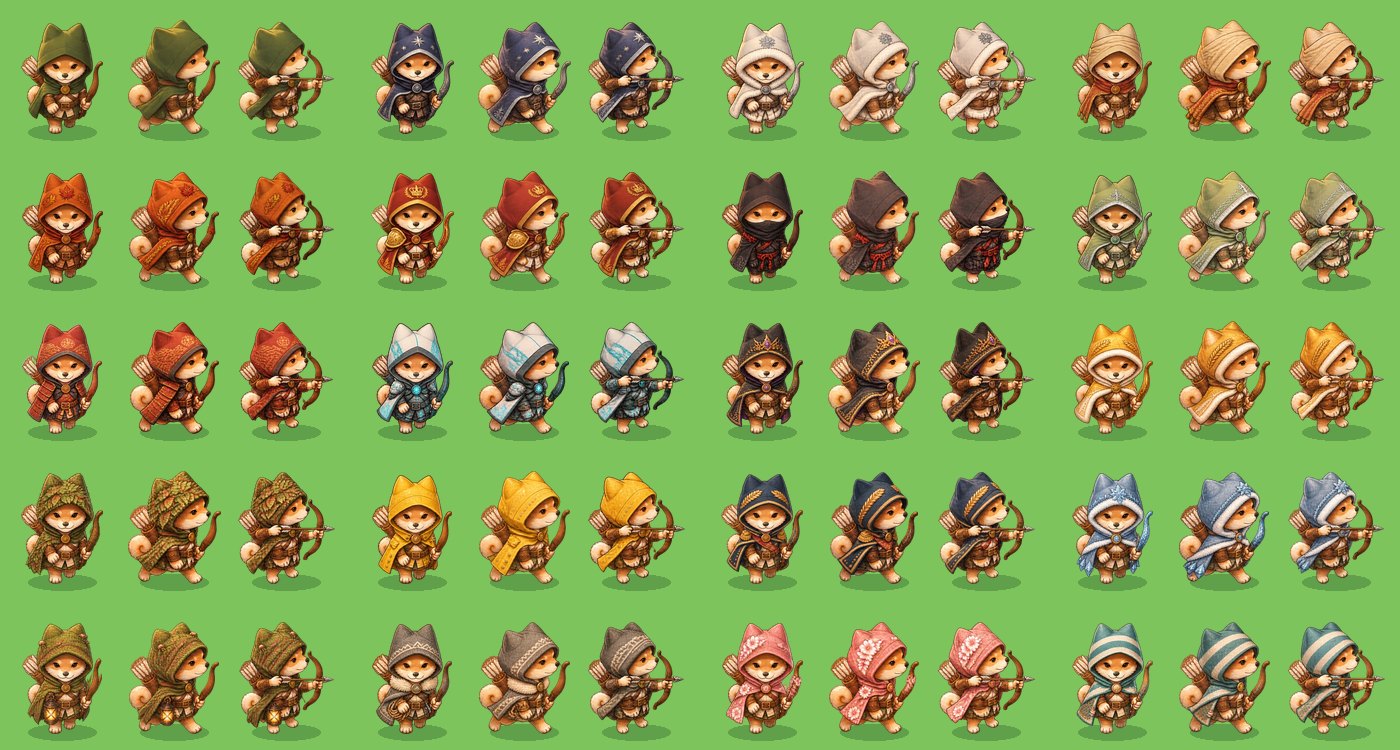
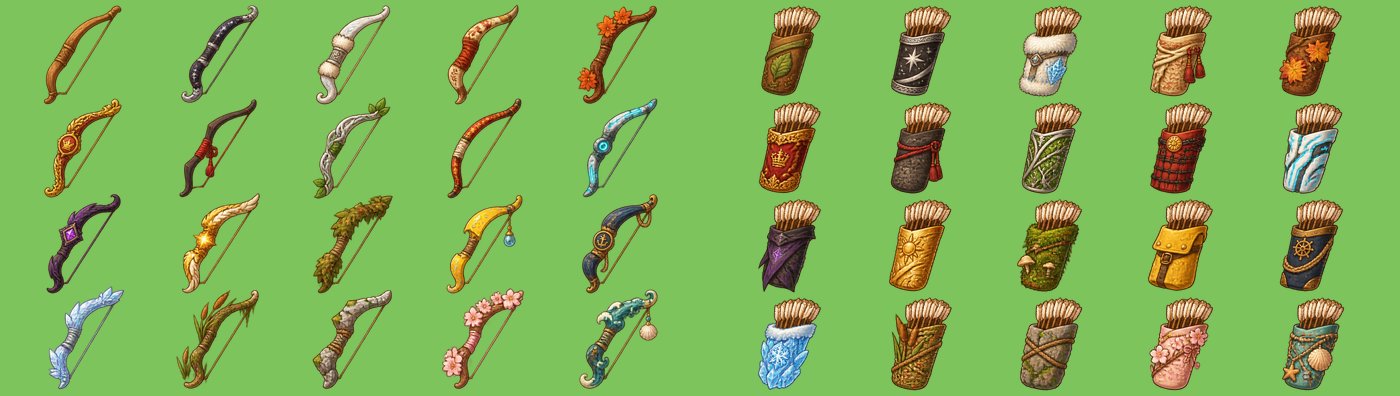
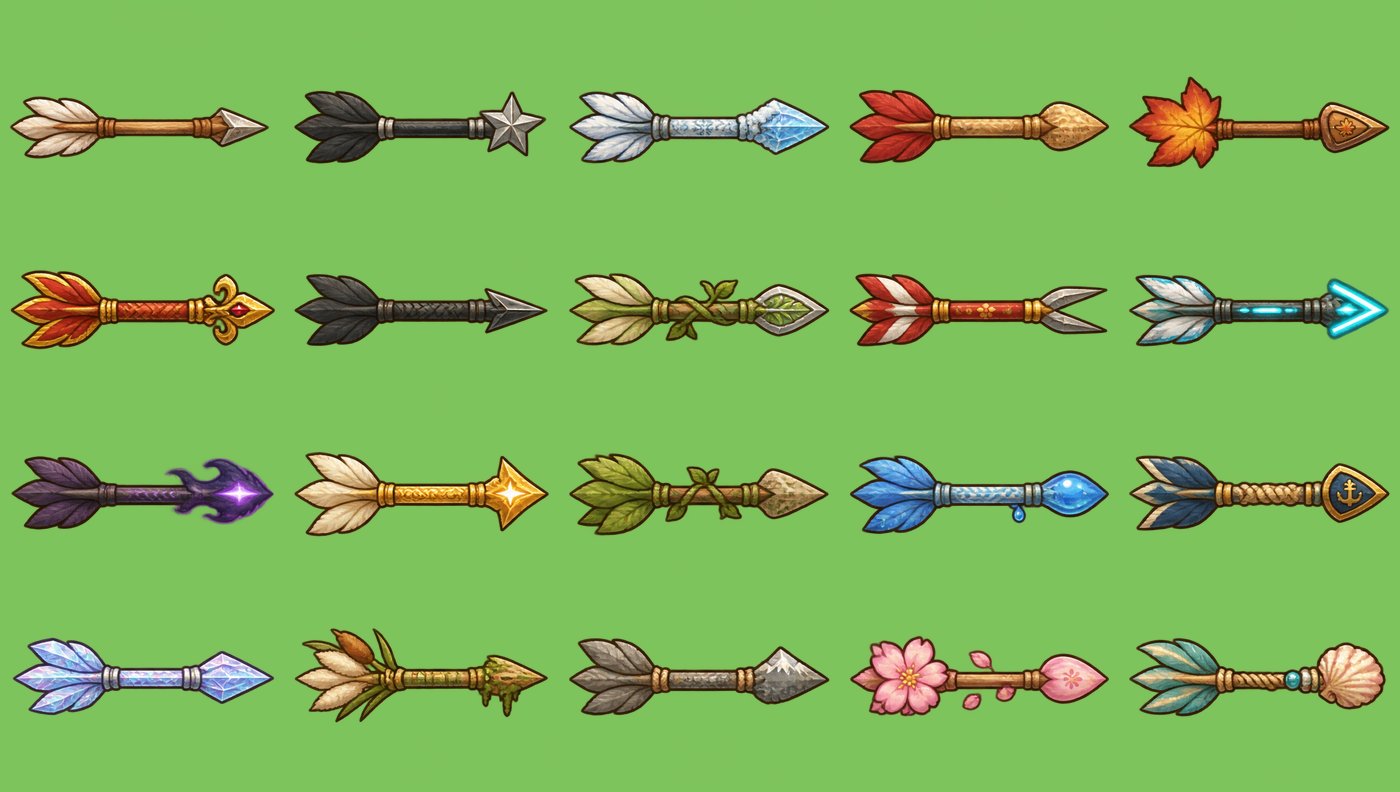
All eighty pieces are redesigned against the archer you chose, so every hood covers the ears the same way and every bow, arrow and quiver matches the outfit it belongs to. Every outfit walks and shoots in the world; arrows are live too, so the set you equip is the arrow that flies.

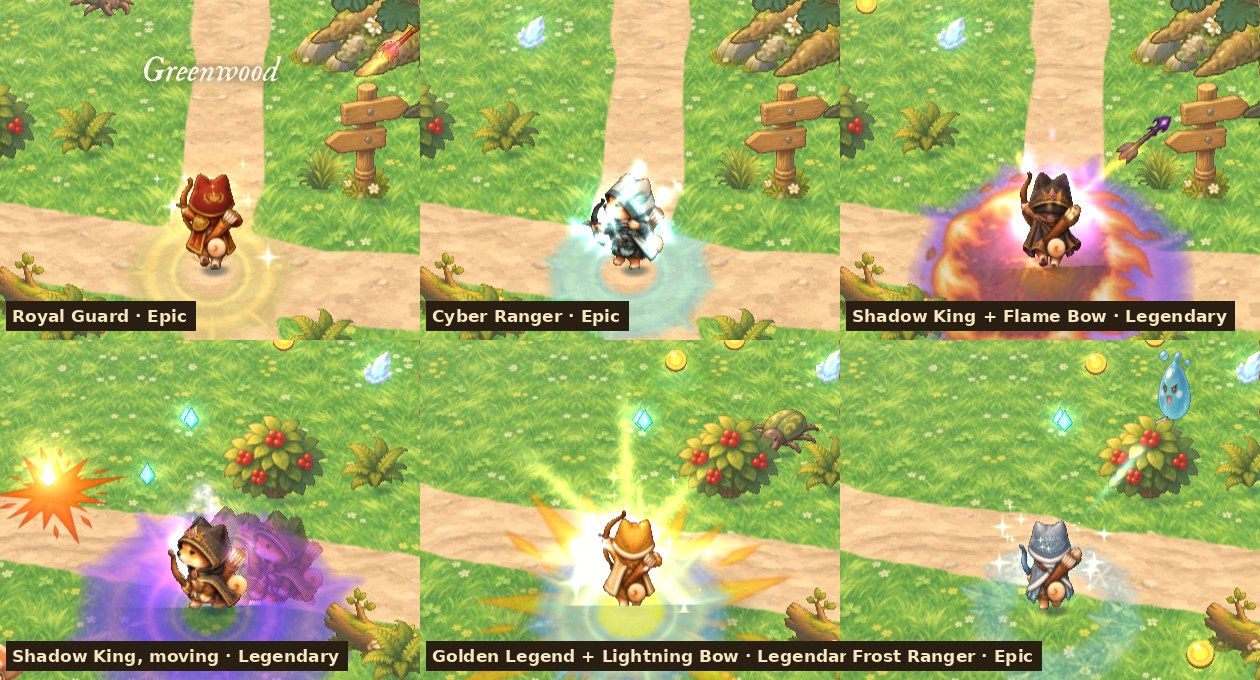
Six close-ups of the archer with gear effects: a golden ring and sparkles on Royal Guard, cyan arcs on Cyber Ranger, a ring of fire and violet light on Shadow King, violet afterimages while he runs, a sunburst on Golden Legend, and falling frost on Frost Ranger
Gear that shows what it is. Epic pieces get an aura and one circle on the ground. Legendary pieces get two rings, a larger aura, afterimages as he runs, and — for the lightning pieces — real strikes from above. The bow's effect sits at the bow hand and grows as he draws; the quiver's sits at his back; arrows carry a trail in their own element and burst in it when they land.
ElementOutfitBowArrowsQuiver
Gilded lightRoyal GuardRoyal WarbowGilded BodkinsRoyal Quiver
Spirit motesElven WayfinderElvenwood BowWayfinder Shafts, Spirit ShaftsWayfinder Quiver
Crimson cutsSamurai RangerYumi of the BladeHunter's BarbsSheath Quiver
Static arcs / runesCyber RangerPulse BowIon BoltsRunestone Quiver
FrostfallFrost RangerCrystal Ice BowFrostbite HeadsGlacier Quiver
Shadowflame / hellfireShadow KingFlame BowHellfire ShaftsHellfire Quiver
Sunburst / lightningGolden LegendLightning Bow—Sunlit Quiver

Bold is Legendary; the rest are Epic. Names and rarities are the live game's. Two of the bows also do what their name says: every third arrow from the Lightning Bow arcs to a second monster, and every fifth from the Flame Bow sets its target burning — stand-ins for the live Static and Searing effects.

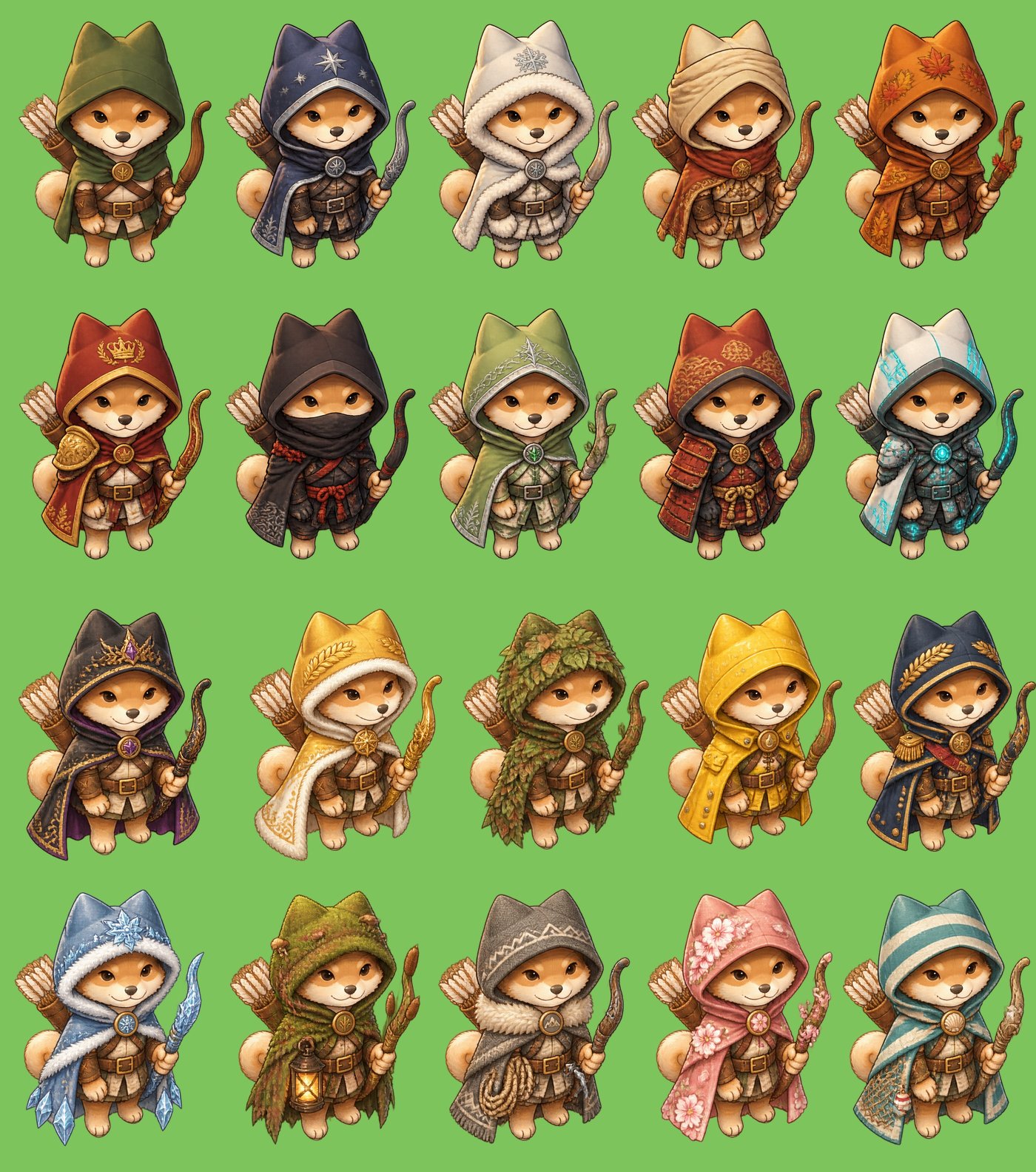
All twenty outfits on the redesigned archer, from Forest Ranger to Coast Ranger
The twenty outfits. Forest Ranger, Night Stalker, Snow Scout, Desert Nomad, Autumn Warden, Royal Guard, Ninja Archer, Elven Wayfinder, Samurai Ranger, Cyber Ranger; then Shadow King, Golden Legend, Ghillie Scout, Rain Ranger, Ranger Captain, Frost Ranger, Marsh Ranger, Mountain Ranger, Blossom Ranger, Coast Ranger.
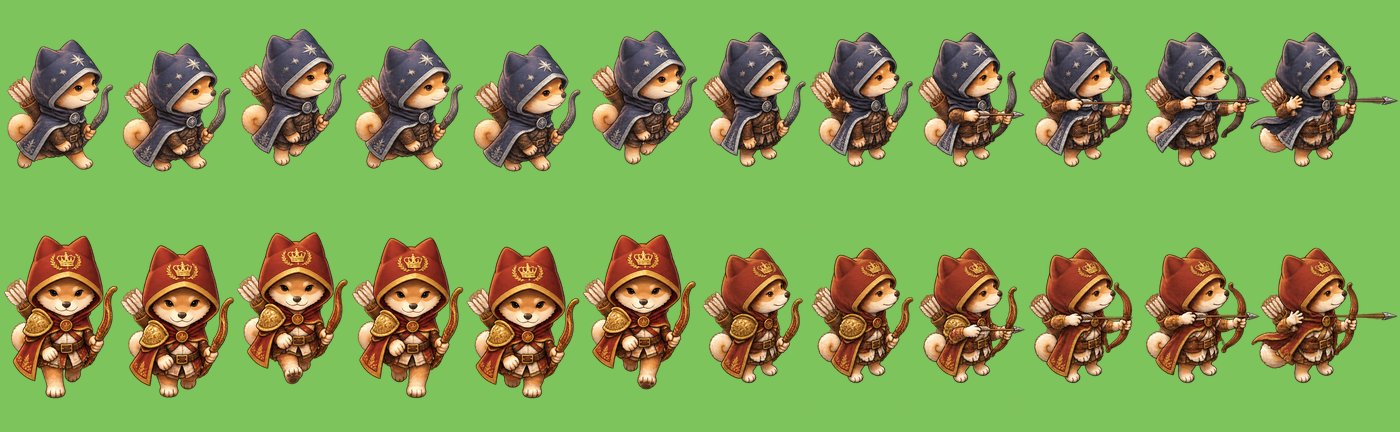
Walk and bow-shot animation strips for the Night Stalker and Royal Guard outfits
Animating an outfit is a re-dress, not a redraw. Each set was made by handing the Forest Ranger's six sheets back with the outfit swapped: same poses, same timing, same size. Night Stalker and Royal Guard are shown here.
All twenty outfits, each shown walking toward the viewer, walking sideways and at full bow draw
All twenty, in motion. One walking frame south, one east, and the full draw, for every outfit. Each has the complete thirty-six frames behind it, and every one of them is wearable in the viewport now. Only the outfit he has on is kept in memory.
Twenty bows and twenty quivers in matching themes
Bows and quivers. One of each per outfit theme.
Twenty arrows, each with its own head and fletching
Arrows. Twenty heads and fletchings, drawn pointing right so they drop straight into the projectile slot.
Spells and secrets

New spell art, and chests to find

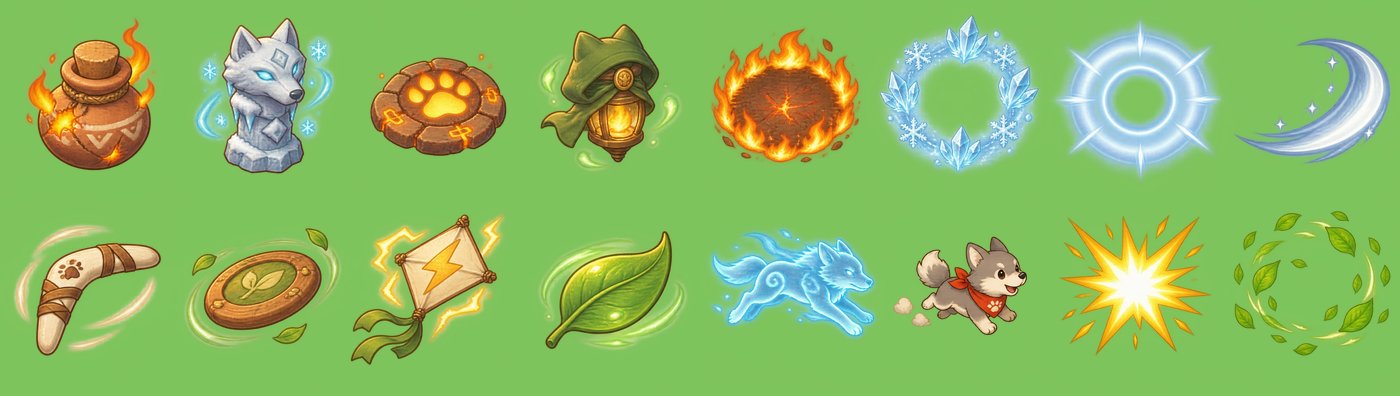
Sixteen spell sprites: ember pot, frost totem, firepaw mine, hood lantern, bone boomerang, frisbee, thunder kite, leaf, fire ring, frost ring, howl ring, moonbeam, spirit wolf, wolf pup, impact burst, leaf swirl
Sixteen spell sprites. Objects on the left, ground and air effects on the right. Live in the viewport: Leaf Ring, Ember Pot, Frost Totem, Bone Boomerang and the wolf pup by default; Firepaw Mine, Moon Howl and Thunder Kite from the Skills menu. Ground effects are real quads lying on the terrain, so a fire patch follows a slope.
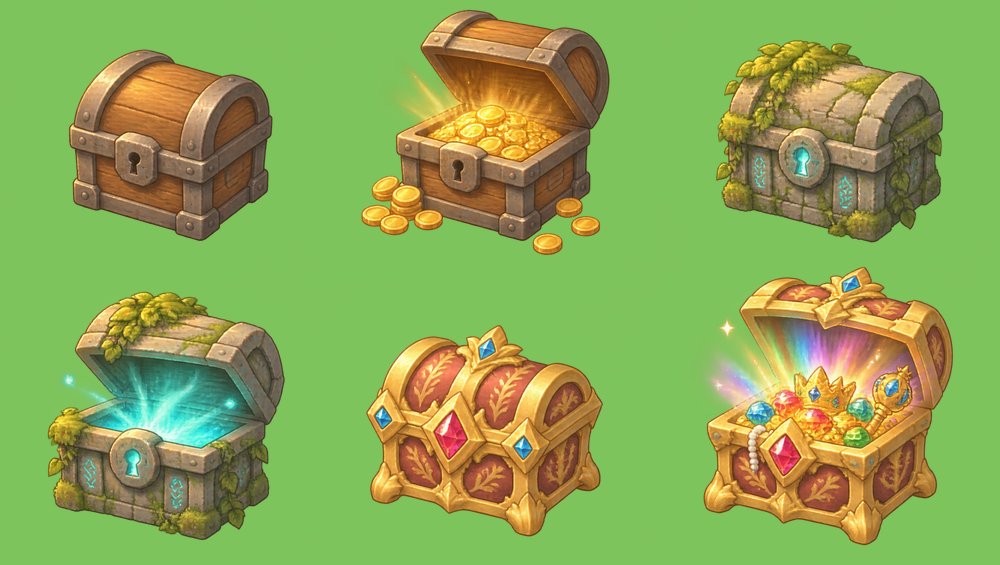
Three treasure chests, each closed and open: wooden, mossy stone with a rune lock, and golden
Three tiers of chest. Wood, rune-locked stone, and gold. Walk into one and it bursts. Twenty-four across the map, and the ones inside a sealed region wait there until it opens. They sit where a curious player looks: behind the Elder Tree's trunk, behind the watchtower, past the big cherry at the top of the Shrine, on the far shore of the lake, in the corners of the map.
The map

One map, opened arena by arena

Normal mode keeps the live structure — six arenas in order, mini-boss at 60 seconds, boss at 110, the arena ends when the boss dies — but the arenas are now regions of one map. You start in Greenwood with everything else sealed. Each boss kill lifts the next seal: Old Courtyard, Lantern Marsh, Frostpine Pass, Ember Canyon, Moonlit Shrine. Regions you have cleared stay open, so by the last arena you can walk the whole map. Clearing all six turns it into free roam: nothing sealed, every boss at home, and the camp becomes safe ground.

The arena clock only runs while you are inside the current arena. Wander back into cleared country and the plate under the portrait says so and waits. Cleared country is also kept quiet, at about a third of the crowd, so backtracking is a breather rather than a second fight.

Pulling monsters across regions

Map size costs nothing. Scenery only exists where the camera is looking, and monsters are one fixed pool around the player — the same number whether the map is 6,000 units or 60,000. What a bigger joined map does risk is a player dragging a pack from region to region until the pool is full of the wrong monsters, or kiting forever. Three rules stop that:

A leash. Each monster remembers the region it spawned in. Two seconds outside it, or more than 2,400 units from where it appeared, and it gives up: it turns for home, fades, and is removed. A refill from where you are. Its slot goes to a monster from the region you are standing in now, so the pool always matches the ground under you. Bosses stay home. An arena's boss chases only while you are in its arena; leave and it walks back to where it appeared.

For a networked or server-checked game the same rule is what keeps it cheap: the server never has to track anything farther than one leash from a player.

The ranger's camp with a ring of pale lights around it and the plate reading Safe ground, bow lowered
Safe ground. The ring of lights round the camp: nothing hostile can enter and he cannot shoot from inside. Every Normal run now starts inside a smaller ring at the fire, with no clock, no score and no monsters until you step out; then the ring goes out behind you, so it cannot be used to run the clock for free. In free roam the camp stays safe.
Greenwoodmeadow, groves, the Elder Tree
Old Courtyardflagstones, the watchtower
Lantern Marshponds, lantern causeway
Frostpine Passsnow hill, the Frozen Crown
Ember Canyonred rock, ember ring
Moonlit Shrineblossom hill, red gates
Harvest Fieldscornfields, the festival
WaterMirror Lake, the river
The Thanksgiving hunt, as the live game runs it

The preview copies the real rule: a Wild Turkey takes 20% of ordinary monster picks everywhere, and in the Harvest Fields they are most of what you meet. The turkey pill in the HUD counts them toward the live milestones — 25, 50, 100, 200, 400, 800. As in the live game, the event reskins each arena's scheduled mini-boss as the Harvest Gobbler: it keeps that boss's attack, and each one counts toward the 1, 2, 4, 8, 16, 32 Ranger-ticket quest. In free roam a Gobbler also holds the festival ground in the Harvest Fields, which are open from the start as part of Greenwood.

What is being replaced

The old sheets, and how far a grade gets you

Four sheets drawn to four different briefs are shipping today. Straight out of the repo:

archer_*.png ×20

Airbrushed fur, thin outline, high-key, no cast shadow, near eye level. Closest in spirit to the new direction, wrong camera angle.

mon_v2.png

Flat cel, heavy saturation, bold ink outline, cartoon proportions. Too loud for a palette with one accent colour.

boss_v3.png

Dark, grimy, heavily rendered, low-key. Values sit in the bottom third — the exact opposite of the brief.

tile_*.jpg

Photographic texture, flat 90° plan view, no light direction at all. Replaced first: cheapest cells, biggest change.

What is in the viewport now, and what is not

None of the old sheets is on screen. What it is not yet: monsters have five frames, not full eight-frame cycles, and one attack each; bosses have four; the archer walks in four directions, not eight; monsters still cross water; he cannot die; the hills are smooth with no cliffs. And all of it is generated reference rather than an artist's production sheets, which shows in small things — a frame that is a few pixels taller than its neighbour, a boss whose strike pose is a slightly different size.

Mechanics

What the open air is actually for

A tilted camera that changes nothing about play is an expensive reskin. The reference game's real lesson is not its lighting, it is that its systems multiply instead of adding: a short list of verbs that combine into a long list of outcomes. The current build adds — six bow tiers, stat cards, outfit traits, a skill tree — and every run reaches roughly the same place. Four proposals, in the order I would build them.

dropped Fuse Removed from the preview. It was this study’s own idea and not part of the game’s design. What it was: Monsters drop materials as a third pickup alongside XP and coins. Fuse one to your arrows at any moment, and re-fuse whenever you like. Fuse two of the same to deepen it; fuse two different ones for a hybrid. This is the whole run's identity, chosen by the player and reversible, instead of a bow ladder that is chosen by the shop and permanent. Why it is first: the engine already has exactly this mechanism. BOW_FX implements long / shatter / sear / static as per-arrow effects with per-tier numbers. Fuse generalises that one table and moves who picks from it. Lowest engineering risk in the list, largest change to how a run feels. What it retires: the six-tier bow ladder collapses into stat bases plus a fusion slot count.
build second Elevation Arenas get real height. High ground gives range and lets arrows clear the first obstacle. Ledges stop walkers but not flyers or ghosts, which finally makes the three AI classes feel different. Updrafts launch you into a short glide — the reposition and escape tool. Slopes speed you downhill and slow you up. Why it matters: this is the mechanic that justifies the camera. Without it the third dimension is decoration. Cost warning: this is the expensive one. Flow-field pathing, the obstacle grid and every spawn rule currently assume a flat plane, and a height field touches all three. Budget it as engine work, not as content.
cheap win Recall One charge, long cooldown: rewind your own position and health by three seconds. Not a shield and not a dash — an undo. It rewards taking a risk you could not otherwise take, and it reads instantly to anyone who has played the reference. Scope: a three-second ring buffer of the player transform and HP. Perhaps 60 lines. Deliberately does not rewind the world, which would be both expensive and unreadable at 200 enemies.
later Constructs Generalise the totems, paw traps and ember pots already in the skill tree into placeable devices paid for with charges earned from kills: a fan that shoves the horde, a rotating beam, a spring that launches you, a bomb barrel. The capstone links two together — fan plus barrel throws the bomb — which is as much construction as a survivor can carry. Hold until Fuse and Elevation are proven. It is the most fun to design and the least necessary, and it competes for the same screen space and attention as the horde.
free variety Weather Per-arena conditions that change what a build is worth mid-run. Rain douses ember fusions and makes slopes unclimbable; storms make lightning arc further; fog shortens auto-aim range; night favours the ghosts. Announced at the arena transition the game already has. Cheapest variety in the list once Fuse exists, because it reprices every fusion without adding a single new one. It is also most of the atmosphere budget — rain and fog are where the renderer earns its keep.
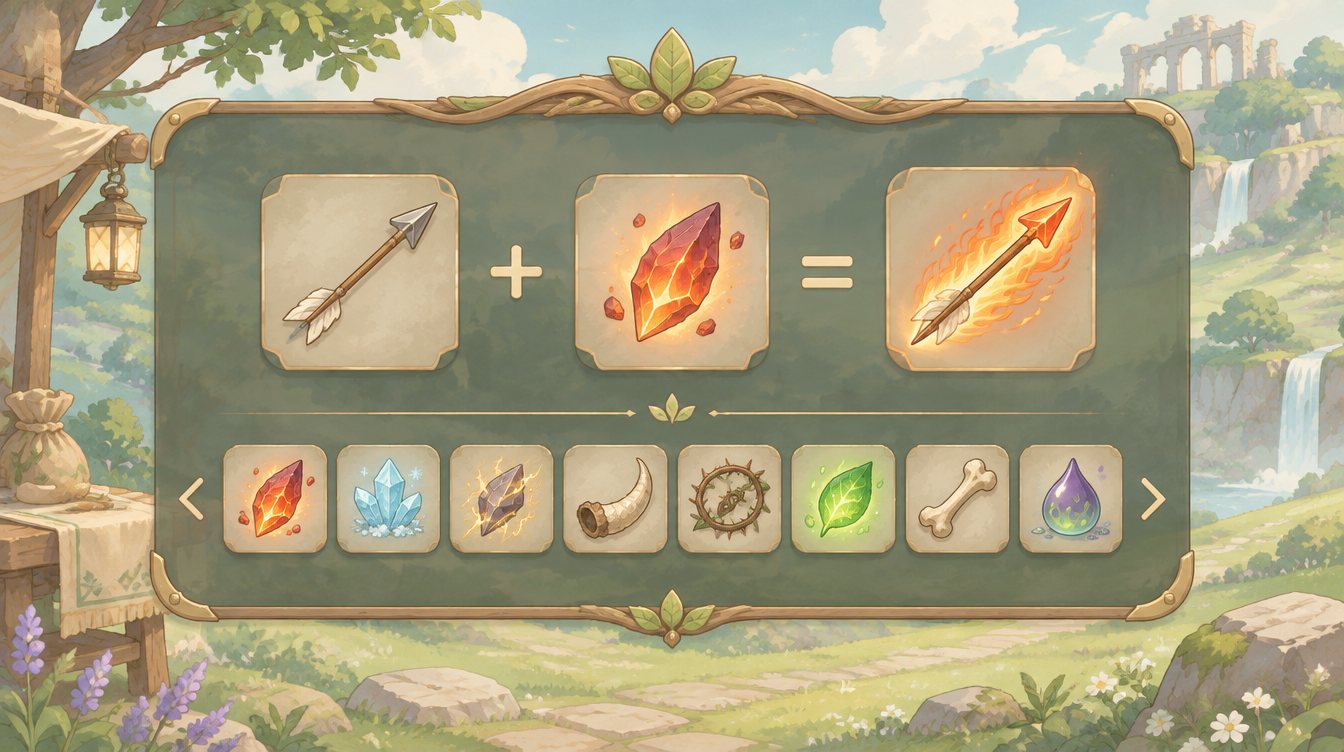
Fusing interface: arrow plus ember shard equals a flaming arrow, with a row of material icons below
Fuse, as the player meets it. One row, one combination, no submenus. It has to be operable with a thumb in the middle of a fight, which rules out anything resembling an inventory screen.
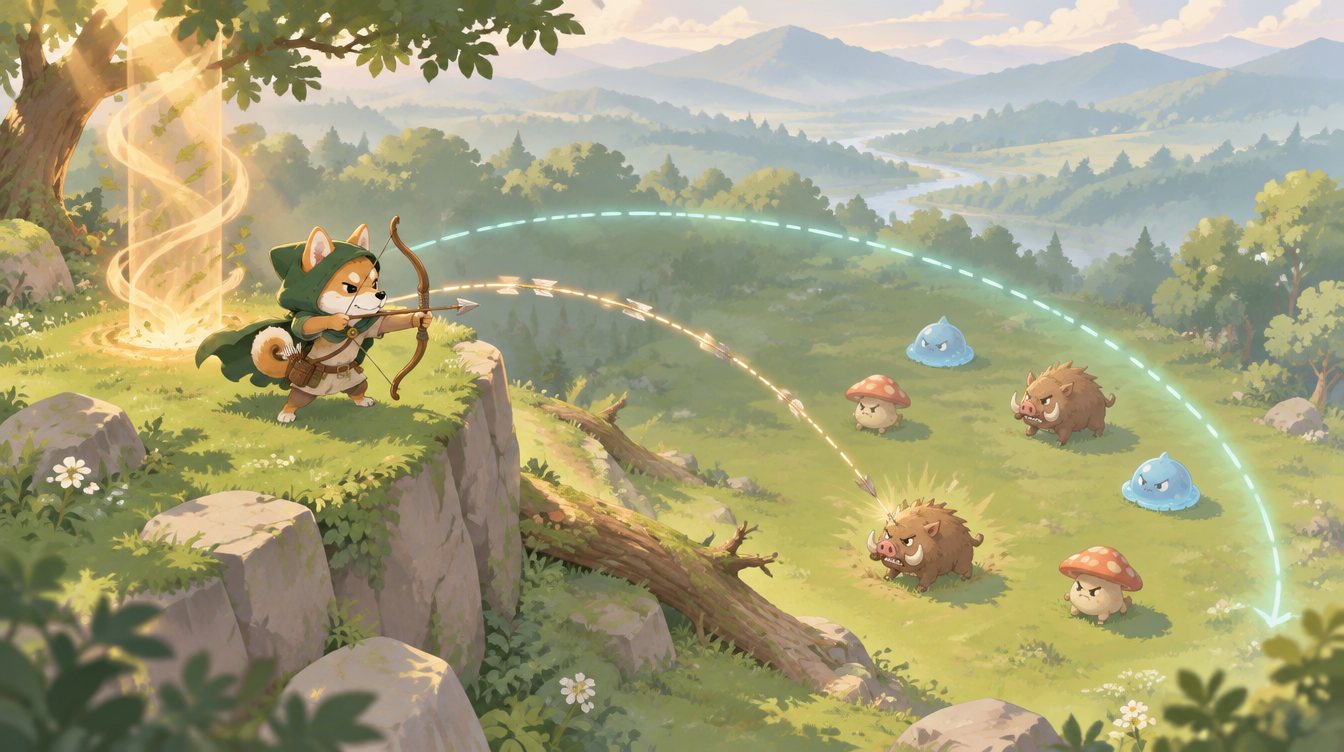
Archer on a rocky ledge firing an arcing shot down into a basin of monsters, with an updraft beside him
Elevation, as the player reads it. High ground extends the arc, the ledge keeps the walkers out, the updraft on the left is the way down and the way out. All three legible without a tutorial.
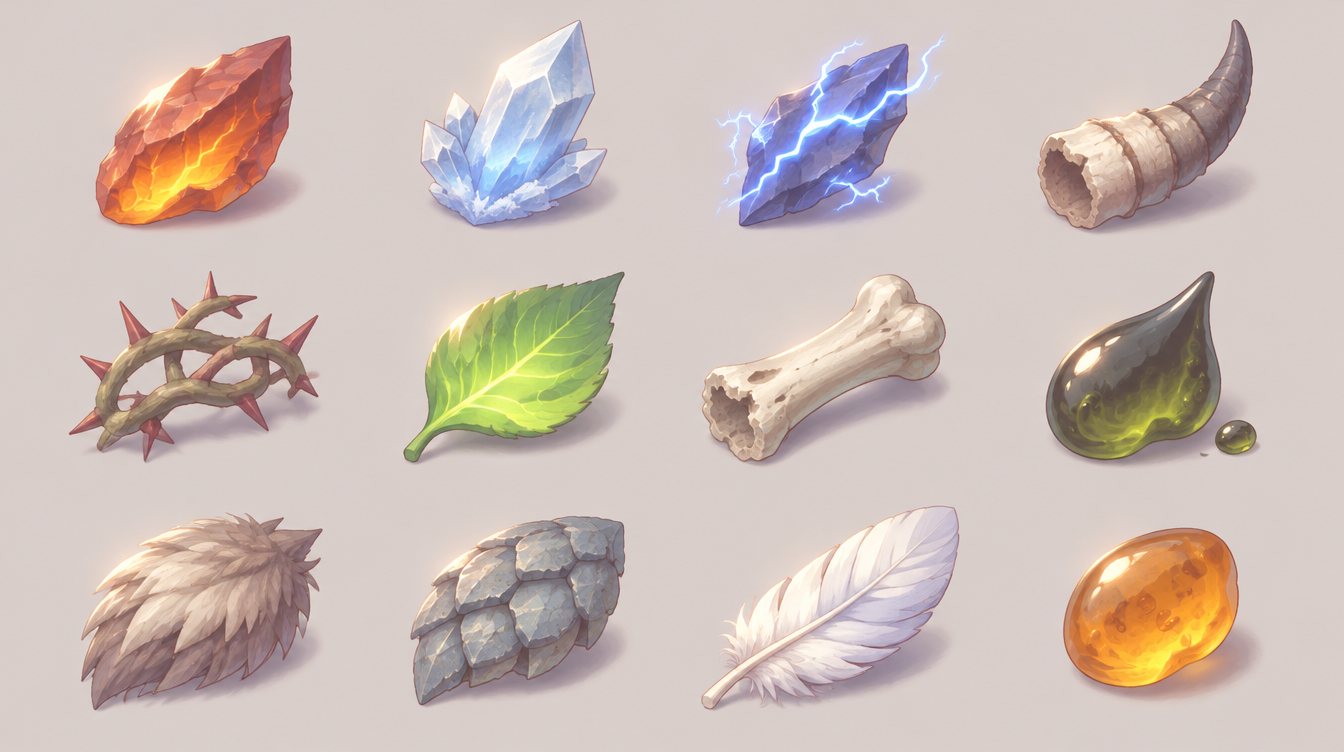
Twelve crafting material icons in a consistent style: ember, frost, lightning, horn, thorns, leaf, bone, ooze, fur, scale, feather, resin
The twelve starting materials. Deliberately small. Twelve singles plus same-material deepening plus pairs is already well over a hundred distinct arrow states, which is more than the game can teach and far more than it needs at launch.
EmberBurn over time
FrostSlow, and bonus damage to the slowed
LightningChains to a second target
HornKnockback, bonus to bosses
ThornsPierce two more
LeafSplits into two on hit
BoneRicochets off terrain
OozeLeaves a slowing pool
FurHoming
ScaleStrips armour
FeatherFaster, longer range
ResinSticks, then detonates

Hybrids are where it gets interesting and where the balancing cost lives. Ember plus lightning is a plasma bolt that arcs and burns. Frost plus ooze freezes the pool into a sheet. Resin plus leaf is a cluster bomb. There is no need to author all 66 pairs — ship perhaps fifteen hand-made ones, and let every other pair resolve to "both effects, each at 60%", which is a perfectly good answer and costs nothing.

The build

Level-up cards and the Paw Tree

Both screens keep the live game's structure and numbers and change only how they look and read. Names, tiers, costs, gates and descriptions are read straight from treedata.js, stats.js and the ability deck in engine.js, so nothing here needs re-balancing to ship.

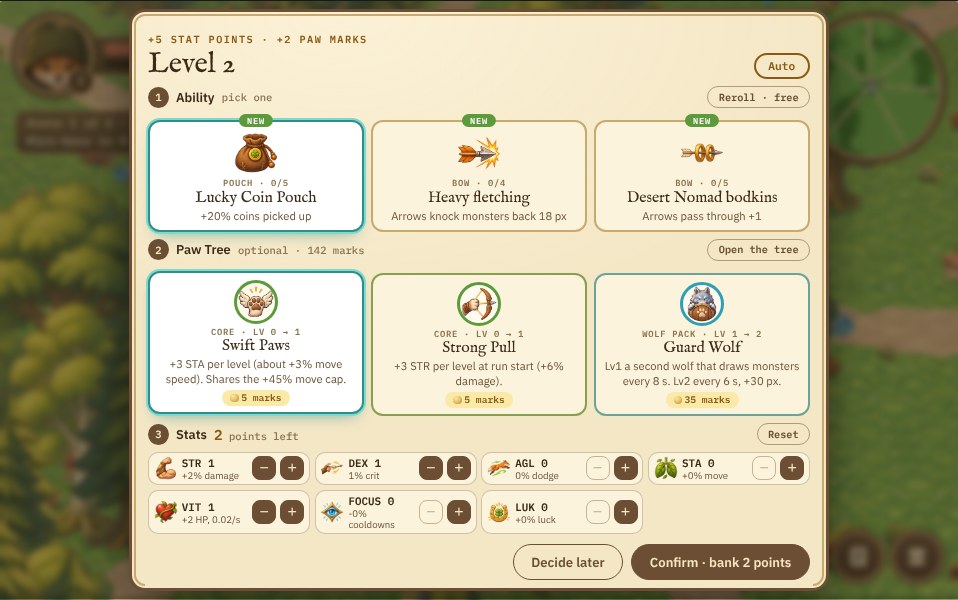
The level-up panel: three ability cards with one selected, three Paw Tree nodes with their costs, seven stat rows with plus and minus buttons, and Decide later and Confirm buttons
Level up. Three rows, top to bottom in the order you decide them. 1 Ability: one of three cards from the live deck, with how many you hold and a reroll (one free, then 100 coins, doubling). 2 Paw Tree: three nodes you could buy right now, coloured by branch, with the level change and the price; optional. 3 Stats: five points across STR, DEX, AGL, STA, VIT, FOCUS and LUK, each showing what it is worth at its current value using the live curves. Unspent points bank. Auto hands the picking to the live auto-draft order.
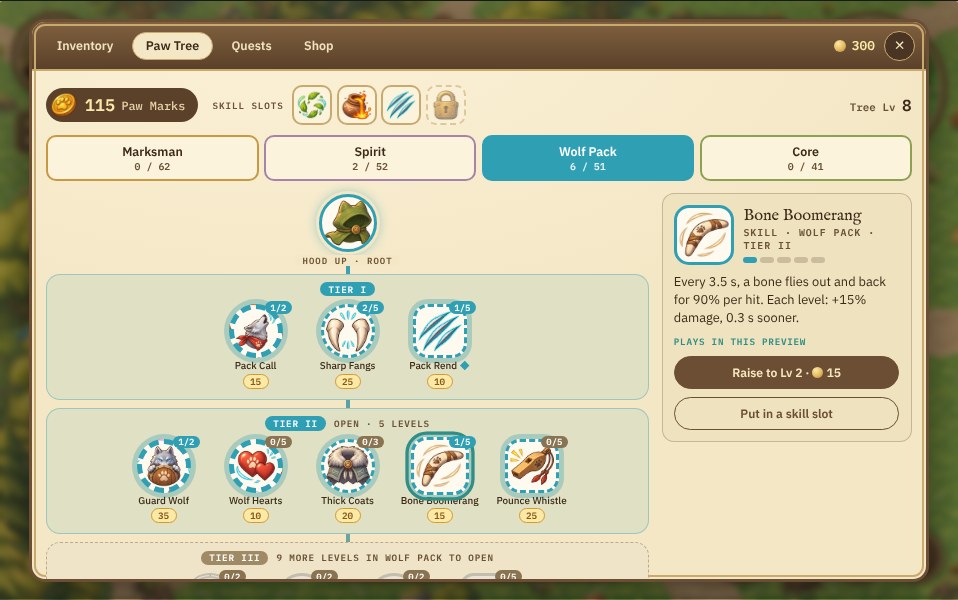
The Paw Tree page on the Wolf Pack branch: Paw Marks and four skill slots at the top, four branch tabs, the Hood Up root, rows of round and square nodes by tier with level counts and prices, and a detail panel for Bone Boomerang with a Raise button
The Paw Tree. Marksman, Spirit, Wolf Pack and Core, as in the live game. Each branch is a trunk from the Hood Up root through four tiers to a capstone; a tier opens when you have bought 5, 15 or 25 levels in that branch. Round nodes are passives and stats, square ones are slot skills, double-ringed ones are wolves. A dashed, pulsing ring means you can afford it now. The panel on the right is the selected node: level pips, the live text, the price, and for a skill the button that puts it in one of the three slots (the fourth opens from Core).
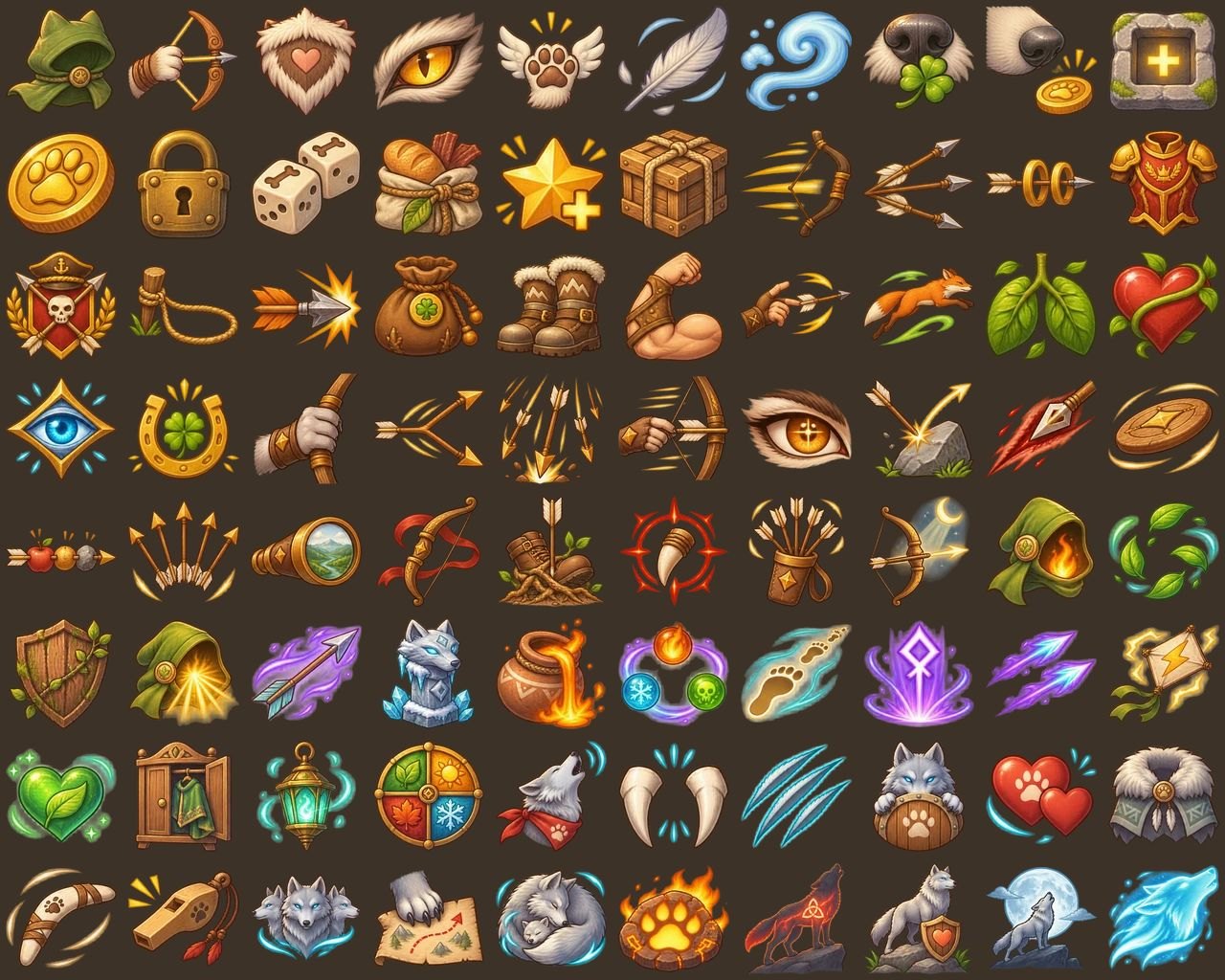
Eighty icons in a grid: hoods, paws, arrows, wolves, totems, boots and stat symbols
Eighty new icons in the game's own style: one for every tree node, every ability card and every stat.
What actually changes play here

The viewport is a stand-in, so only part of the build reaches it: all seven stats, nine of the ability cards, the wolves (Pack Call, Guard Wolf, Bigger Pack, Sharp Fangs, Great Spirit Wolf), eleven slot skills including Pack Rend, Arrow Rain, Hood Lantern and Quiver Storm, and a few passives. Each node says whether it plays here. The rest are listed with their live text so the page can be judged whole.

Interface

One kit for every screen

The old screens felt cheap for a specific reason: each was styled on its own, with flat rectangles and system-looking lists, so nothing told you they belonged to the same game as the art. The four in the viewport are built from one small kit — a carved frame, a parchment sheet, brass edging, pill tabs, a rarity-coloured tile and one button — and that kit is the same wood and brass as the HUD around the playfield.

What these screens are

They are working HTML and CSS, which is what the real game uses, so the kit can be lifted onto the existing React components. What they are not is wired to the real economy: prices, stats and coin rewards here are placeholders. Item names and rarities are now the live game's; the art for each was drawn to the outfit theme it belongs to, so the Flame Bow and Lightning Bow in particular want their own drawings.

Production

What it costs and how it lands

Full commitment means no asset survives. Counted off the repo plus the new systems:

AssetCellsNote
Archer — 20 outfits × 36 frames (walk and shot, three facings)720Done, all twenty.
Monsters — 36 × 2 frames72Done. A third frame and an attack pose each would add 72.
Bosses — 11 × 3 poses33Done: idle, wind-up, strike.
Scenery and ground70Done. Add roughly 15 for cliffs and ledges if Elevation goes ahead.
Outfit, bow, arrow and quiver designs80Done as designs; arrows are live as projectiles.
Spell sprites and chests22Done. The live game has more spell states than the eight shown here.
Material icons and fused arrow states~3012 material icons done; fused states still tints.
UI kit~35Built in CSS rather than drawn, for the four screens here.
Total~1,060About 1,040 exist as generated reference. What is left is fused-arrow states and anything Elevation needs.

Split the dog from the outfit and the total drops by about a third. One archer body sheet of 20 cells plus 20 cloak-and-gear overlays composited at runtime as a second billboard layer, instead of 400 bespoke cells. Every future outfit then costs a fraction of what it costs today. The price is that an outfit can no longer radically change his silhouette. This has to be decided before anyone draws outfit number one — it is worth doing at the same time or not at all.

Performance

The big map costs nothing extra, which is the point of building it this way. The world is two 1024×1024 region maps sampled by the ground shader — eight ground paintings and water blended per pixel — and scenery is scattered deterministically from those same maps only where the camera is looking. Nothing outside the view exists. One instanced mesh per atlas, billboarding in the vertex shader, depth sorting by the depth buffer through alpha test: push the crowd slider to 600 and the draw-call counter does not move. Under software rasterisation in a container with no GPU at all, 600 monsters in the densest biome — about 1,500 sprites with scenery — drew in ten calls at 20fps, the same rate as with 70 monsters, because the cost there is a CPU doing fragment shading; any real graphics chip is far above that. What I have not measured is a real phone. The atlases on this page are also about 95 MB of uncompressed texture memory, which wants compressed textures and per-biome loading before it ships.

The levers, in order of effect: cap the pixel ratio at 1.5× rather than a phone's 3×; alpha test instead of alpha blend; keep only the equipped outfit sheet resident in VRAM; pad atlases to power-of-two so mipmaps work. The real risk is thermal rather than frame rate — a run is fifteen minutes of sustained load, and a warm phone is a different machine from a cold one.

The 2D canvas renderer stays in the codebase, but as a fallback for devices without WebGL, not as a player-facing setting. It will slowly rot, and that is acceptable.

  1. 01Renderer seamExtract the draw* functions out of engine.js behind an interface, existing canvas as the only implementation. Ships invisible. ~300 lines.
  2. 023D renderer on the old artWhat the viewport above is. Proves perf and the camera on real devices before a cell is redrawn. The palette grade ships here too, so the old art stops fighting itself while the new art is made.
  3. 03Ground, then one pilot characterNine ground cells and the prop kit, then one outfit and three monsters drawn to the contract. Judge the pilot in the engine, at speed, on a phone — never in an image viewer. This is the go/no-go on the art direction.
  4. 04FuseMaterials as a drop type, the fusion table, the one-row UI. Playable and balanced before any elevation work starts, because it changes what every other number in the game is worth.
  5. 05Bosses, monsters, outfitsDescending impact per cell, over a long tail. The game stays playable throughout with mixed-generation art, which is the whole reason to sequence it this way.
  6. 06ElevationHeight field, pathing, ledges, updrafts, and the terrain art it needs. Engine work, gated on phase 3 having settled the look. The riskiest item; it gets its own schedule.
  7. 07Effects, weather, interfaceThe ~20 skill and telegraph effects rebuilt as ground quads and additive billboards, then rain, fog and night, then the UI kit over the existing React components.
Before anyone draws

Four things only you can answer

50°, or something else?Drag the slider and name a number. No playable angle shows any sky, so this is purely about how much floor and how much depth you want — not about keeping the reference's skyline, which is not on the table at any angle you would ship.
Does the dog-and-overlay split happen?It cuts roughly a third off the total and makes every future outfit cheap forever, at the price of constraining how much an outfit can change his shape.
Arrive, or walk?When a seal lifts, this preview offers both: be put at the new region's entrance, or stay and walk there. You said players spawn in the new arena, so that is the first button. Walking is the more interesting one on a map this size, and costs score time. Also still open for free roam: its own leaderboard or none, Hell Mode loops, and boss respawn timers.
Fuse and Elevation, or Fuse alone?Fuse is contained and reuses machinery that exists. Elevation touches pathing, obstacles and spawning, and is where a schedule goes wrong. They are separable, and shipping Fuse first is the safe order.